Professional Enclosure Manufacturer | Custom Solutions
Home > IP68 Plastic Waterproof Enclosures > BWP 10524 – IP68 Industrial IoT Enclosure


Designed for Industrial IoT gateways, remote monitoring systems, smart factory controllers, industrial sensors and edge computing devices.
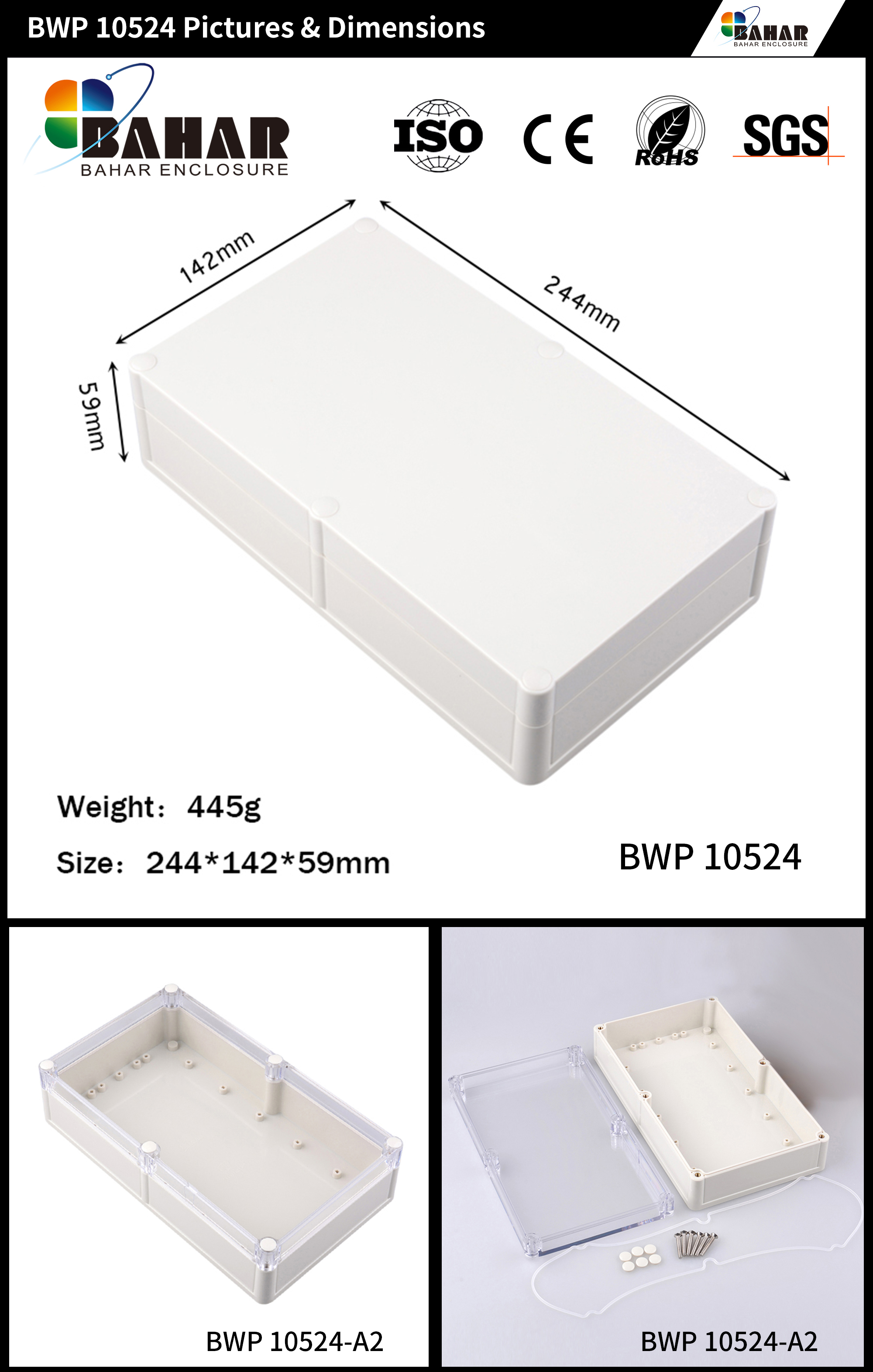
BWP 10524|244 × 142 × 59 mm
Industrial IoT Enclosure projects rarely fail because of software alone. In many real-world deployments, the weakest point is the hardware installed outside the control room. IoT gateways, industrial edge computers, wireless communication modules and distributed controllers are frequently exposed to moisture, airborne contaminants, vibration and rapid temperature changes. While processors continue becoming faster and communication protocols more intelligent, reliable field operation still depends on one often-overlooked component—the enclosure protecting the entire system.
The BWP 10524 Industrial IoT Enclosure has been developed for engineers who need a dependable mechanical platform capable of supporting connected industrial devices throughout years of continuous operation. Rather than viewing an enclosure as a simple plastic housing, modern system designers treat it as an integral part of the electronic architecture. Proper enclosure selection influences installation quality, maintenance efficiency, thermal management, wiring organization and even future hardware expansion.
Digital transformation is no longer limited to centralized PLC cabinets. Modern factories collect information from production lines, storage facilities, energy systems and environmental sensors located throughout an industrial site. These distributed devices generate enormous amounts of operational data that must be processed before reaching cloud platforms or enterprise software.
This is where an Industrial IoT Enclosure becomes essential. Instead of protecting only electronics, it safeguards the physical infrastructure responsible for collecting production data, transmitting information and supporting intelligent decision-making across an entire manufacturing facility.
Traditional control cabinets are usually installed inside electrical rooms where environmental conditions remain relatively stable. Industrial IoT devices operate under completely different circumstances. They are mounted beside conveyors, attached to production equipment, installed inside warehouses or positioned outdoors near utility infrastructure. Every installation exposes electronics to different environmental risks that cannot be addressed simply by selecting higher-quality circuit boards.
Mechanical protection therefore becomes part of the overall system design. Engineers must consider cable routing, connector accessibility, maintenance intervals and future device replacement long before equipment reaches the production floor.
Connecting thousands of industrial assets is relatively easy. Maintaining them efficiently for the next ten years is considerably more difficult. Large manufacturing facilities often contain hundreds of edge gateways distributed across different production areas. If every installation uses different enclosure dimensions, different mounting arrangements and different cable entry locations, maintenance rapidly becomes inefficient.
Many successful OEM manufacturers therefore standardize around a limited number of enclosure platforms. Using the same mechanical architecture across multiple products simplifies documentation, inventory management, technician training and spare-part availability while reducing engineering effort during future product development.
Industrial IoT software evolves continuously. New communication protocols appear, cybersecurity requirements become stricter and edge AI applications require more powerful processors. Hardware inevitably changes alongside software. A properly selected enclosure should therefore provide enough flexibility to accommodate additional communication modules, upgraded controllers or expanded I/O hardware without forcing engineers to redesign the complete mechanical structure.
The internal volume of the BWP 10524 Industrial IoT Enclosure allows system integrators to create organized installation zones for gateways, power supplies, industrial communication interfaces and auxiliary electronics while preserving convenient maintenance access throughout the equipment lifecycle.
Secondary machining performed during final assembly often introduces dimensional variation between production batches. CNC preparation directly at the enclosure manufacturer eliminates this problem while reducing production time. Bahar provides professional OEM enclosure customization including precision CNC machining, connector cut-outs, threaded openings, UV printing, laser engraving and custom identification according to customer drawings.
Manufacturers developing complete Industrial IoT solutions can also standardize future products using Bahar’s Plastic Waterproof Enclosure Series, allowing different gateway models to share a consistent mechanical platform while supporting different electronic configurations.
Industrial IoT is often associated with cloud computing, artificial intelligence and real-time analytics, yet every digital system still relies on physical hardware installed in demanding industrial environments. Organizations such as the Industry IoT Consortium (IIC) and the International Society of Automation (ISA) continue emphasizing interoperability, reliability and lifecycle management as key requirements for connected industrial infrastructure. Selecting a dependable Industrial IoT Enclosure therefore contributes not only to equipment protection but also to long-term operational stability, easier maintenance and scalable digital transformation strategies.
Launching an Industrial IoT project is usually exciting. Sensors begin collecting data, dashboards display real-time information and production managers gain visibility into equipment performance. However, the real challenge appears several years later when hundreds of distributed devices require maintenance, firmware updates or hardware replacement. At this stage, the quality of the Industrial IoT Enclosure becomes just as important as the processors and software running inside it.
Facilities that expand rapidly often install IoT gateways wherever space is available. Some are mounted beside conveyors, others near compressors, electrical panels or utility equipment. Without standardized enclosure selection, every maintenance visit becomes different. Technicians spend valuable time identifying cable routes, locating communication modules and verifying wiring before solving the actual problem.
Successful manufacturers rarely evaluate an enclosure by purchase price alone. Instead, they calculate the total operational cost over the lifetime of the equipment. A standardized Industrial IoT Enclosure reduces technician training, simplifies spare-part inventory, minimizes documentation complexity and accelerates field maintenance. These operational savings often exceed the initial hardware investment many times over.
Using identical enclosure platforms across multiple gateway models also allows engineering teams to reuse mounting plates, electrical drawings and installation procedures, reducing development time for future product generations.
Industrial communication networks operate continuously, often transferring thousands of data packets every second between sensors, PLCs, cloud servers and supervisory systems. While engineers frequently optimize communication protocols and network architecture, mechanical stability is sometimes overlooked. Loose connectors, excessive cable tension or poorly supported communication modules may eventually interrupt otherwise reliable network infrastructure.
An organized Industrial IoT Enclosure allows Ethernet switches, industrial gateways, cellular routers and edge computing devices to remain securely installed while maintaining sufficient clearance for communication cables and service access.
Technology evolves faster than industrial equipment. A gateway installed today may require additional interfaces next year to support new wireless protocols, AI processors or cybersecurity hardware. Selecting an enclosure with no allowance for future expansion forces manufacturers into unnecessary redesign projects every time electronics change.
The BWP 10524 Industrial IoT Enclosure gives system designers flexibility to integrate future communication hardware without replacing the complete mechanical platform. This reduces redesign costs while extending the commercial lifespan of industrial products.
Cybersecurity discussions normally focus on software updates, encrypted communication and authentication protocols. However, physical access protection remains equally important. If communication hardware can easily be tampered with or connectors remain exposed to unauthorized access, digital security measures become less effective. A properly selected Industrial IoT Enclosure contributes to the physical security strategy by protecting communication equipment and reducing opportunities for accidental or intentional interference.
OEM manufacturers increasingly request factory-prepared enclosures instead of performing manual machining after delivery. Bahar offers precision enclosure customization services including CNC machining, threaded holes, connector openings, laser engraving and UV printing according to customer CAD drawings. Receiving production-ready enclosures shortens assembly time while improving consistency across every manufactured unit.
Manufacturers can also combine this model with other products from the Plastic Waterproof Enclosure Series to establish a unified enclosure family for Industrial IoT gateways, communication controllers and distributed automation systems.
Industrial digitalization continues expanding into every manufacturing sector, from energy management and predictive maintenance to autonomous logistics and smart utilities. Organizations including the Industry IoT Consortium (IIC) and the LF Edge emphasize scalable edge infrastructure as a foundation for modern industrial applications. Selecting a reliable Industrial IoT Enclosure enables manufacturers to deploy connected devices with greater confidence, improve long-term maintainability and create a mechanical platform capable of supporting future generations of industrial innovation.