Professional Enclosure Manufacturer | Custom Solutions
Home > IP68 Plastic Waterproof Enclosures > BWP 10525 – IP68 Energy Monitoring Enclosure


Suitable for energy monitoring systems, power analyzers, smart metering devices, electrical monitoring controllers and industrial energy management equipment.
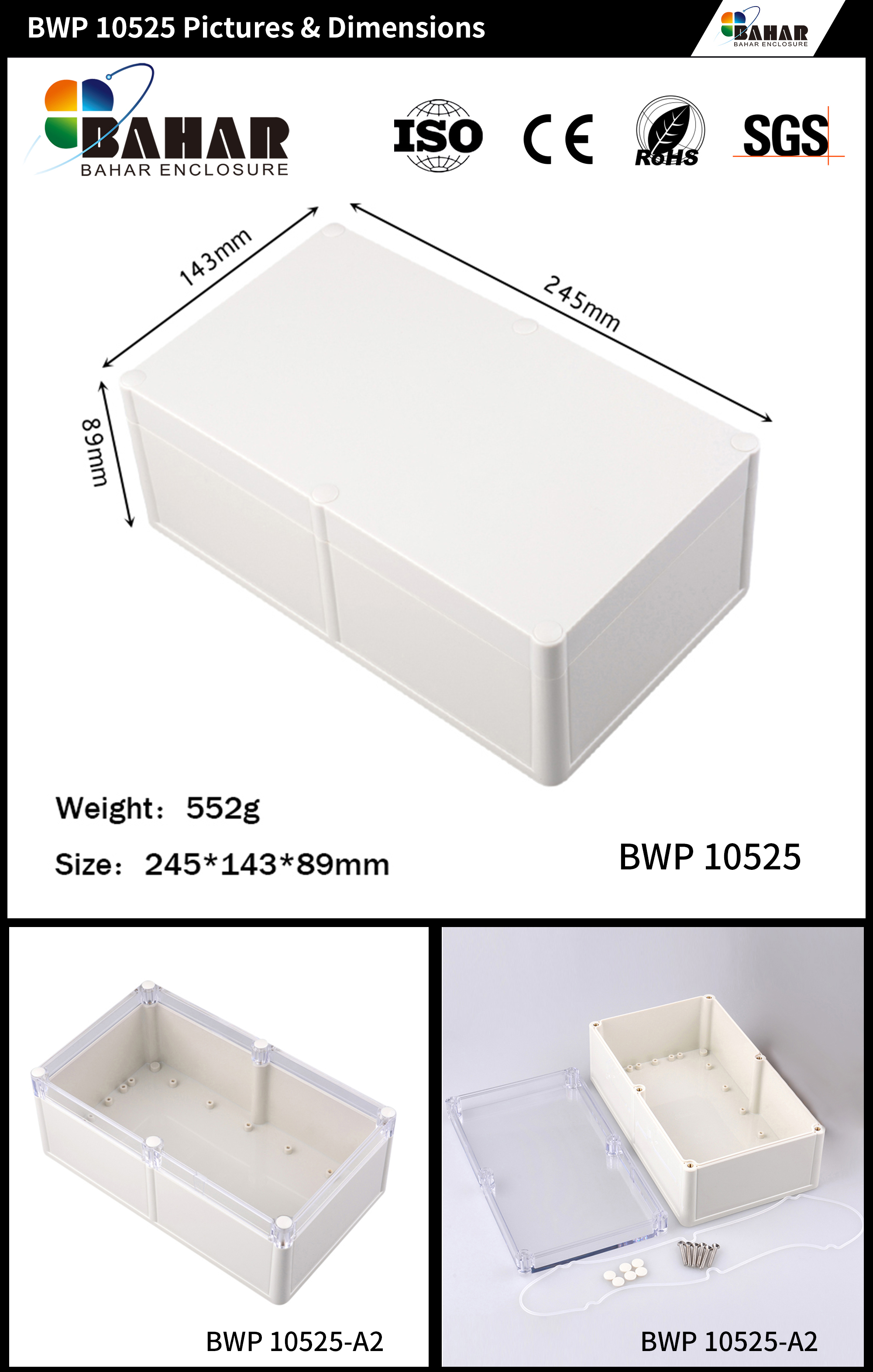
BWP 10525|245 × 143 × 89 mm
Energy Monitoring Enclosure solutions have become increasingly important as industries focus on reducing energy consumption, improving operational efficiency and meeting sustainability targets. Modern factories, commercial buildings and utility facilities continuously collect electrical data from hundreds of monitoring points, transforming raw measurements into actionable information for maintenance teams and energy managers. Protecting the electronics responsible for acquiring and transmitting this information is essential for maintaining uninterrupted monitoring performance.
The BWP 10525 Energy Monitoring Enclosure provides a reliable mechanical platform for integrating power monitoring electronics, communication gateways, metering controllers and industrial data acquisition devices. Instead of functioning solely as a protective housing, the enclosure becomes part of the overall monitoring infrastructure by improving installation quality, simplifying maintenance and supporting long-term operational reliability under demanding environmental conditions.
Electricity is no longer viewed simply as a utility expense. Modern manufacturers analyze energy consumption with the same level of attention given to production output and product quality. Every production line, compressor, HVAC system, pump station and distribution panel generates valuable operational information that helps identify inefficiencies before they become costly problems.
An Energy Monitoring Enclosure protects the hardware responsible for collecting this information while allowing sensors, communication modules and monitoring controllers to operate reliably throughout years of continuous industrial service.
Traditional energy measurements focused primarily on incoming electrical supply. Today’s facilities distribute intelligent meters throughout entire buildings and production plants to monitor individual machines, manufacturing cells and critical infrastructure. This decentralized architecture places electronic monitoring equipment much closer to harsh operating environments where dust, moisture and mechanical vibration become everyday challenges.
Because of this transition, enclosure selection has become an engineering decision rather than simply a purchasing decision. Reliable protection directly contributes to measurement stability, equipment availability and long-term maintenance efficiency.
Energy management systems rely on accurate data collected over long periods of operation. Loose connectors, cable strain, poor environmental protection or difficult maintenance access may gradually affect measurement reliability even when the electronic hardware itself remains fully functional. Engineers therefore consider enclosure layout, cable organization and service accessibility as important elements of overall system accuracy.
The BWP 10525 Energy Monitoring Enclosure offers sufficient installation space for communication devices, monitoring electronics, terminal blocks and auxiliary power equipment while helping technicians maintain organized wiring throughout the operational life of the system.
Commissioning day is often considered the finish line of an energy monitoring project. Current transformers are installed, communication links are established and dashboards immediately begin displaying electrical data. Everything appears to function perfectly. However, experienced facility managers know that the real evaluation starts several months later, when the monitoring network must continue delivering accurate information despite environmental changes, maintenance activities and continuous equipment operation.
Many monitoring systems lose reliability not because of defective electronics, but because the surrounding mechanical environment was underestimated during the original design stage. Moisture enters poorly protected installations, cable routing becomes increasingly disorganized after maintenance, and additional communication devices are installed wherever space happens to be available. Gradually, a well-designed monitoring architecture becomes difficult to service and even harder to expand.
A professional Energy Monitoring Enclosure is expected to do much more than protect electronic hardware during the first installation. Throughout its operational lifetime, it should simplify preventive maintenance, accommodate future communication upgrades, provide organized cable management and allow technicians to replace failed components without interrupting neighboring monitoring equipment.
The enclosure therefore becomes part of the maintenance strategy rather than simply part of the mechanical design. Engineers who evaluate lifecycle costs instead of initial purchase prices usually recognize that enclosure quality has a direct influence on operational efficiency for many years.
Energy analytics platforms rely on accurate historical information. Small interruptions in communication, unstable power supplies or inconsistent sensor readings may appear insignificant individually, yet over months of operation they reduce confidence in trend analysis and predictive maintenance algorithms. Reliable analytics therefore begin with reliable hardware installation.
The BWP 10525 Energy Monitoring Enclosure provides sufficient installation volume for power analyzers, communication gateways, industrial routers and auxiliary electronics while helping engineers maintain clean internal wiring and organized equipment layouts. Stable hardware installation contributes directly to stable data collection.
Industrial facilities rarely remain unchanged. New production lines are added, electrical loads increase and additional measurement points become necessary. A monitoring enclosure designed only for the original project often reaches its capacity much sooner than expected. Engineers are then forced to install secondary boxes beside the original enclosure, increasing installation complexity and creating unnecessary maintenance challenges.
Planning for future expansion from the beginning allows organizations to integrate additional communication modules, wireless gateways or monitoring controllers without replacing the complete enclosure infrastructure. This approach preserves engineering investment while supporting continuous facility growth.
Modern energy monitoring systems influence far more than electrical engineering departments. Production managers evaluate machine efficiency, financial teams analyze utility costs, sustainability officers prepare environmental reports and maintenance engineers identify equipment operating outside normal conditions. Every decision depends on reliable information generated by distributed monitoring hardware.
Because of this, selecting a dependable Energy Monitoring Enclosure contributes indirectly to operational planning, maintenance scheduling and energy optimization across the entire organization. Protecting electronics ultimately protects the quality of the business decisions derived from the collected data.
For OEM manufacturers producing monitoring equipment in large quantities, consistency is often more valuable than speed alone. Factory-prepared enclosures reduce assembly variation by ensuring connector openings, mounting holes and identification markings are produced using repeatable CNC processes rather than manual workshop modifications.
Bahar provides complete OEM enclosure customization, including precision machining, laser engraving, UV printing and custom cut-outs according to customer engineering drawings. This manufacturing approach improves repeatability while reducing installation time during final equipment assembly.
The future of industrial energy management is moving toward AI-assisted optimization, edge analytics, distributed renewable energy integration and real-time digital twins. Organizations such as the U.S. Department of Energy and the International Organization for Standardization (ISO) continue encouraging smarter energy management practices supported by accurate operational data. By combining durable ABS construction, dependable IP68 environmental protection and flexible customization capabilities, the BWP 10525 Energy Monitoring Enclosure provides a reliable mechanical foundation for next-generation monitoring systems that must remain accurate, maintainable and adaptable throughout years of industrial operation.
Unlike many industrial control systems that can be temporarily shut down for servicing, energy monitoring networks are expected to continue collecting information even while maintenance work is taking place elsewhere in the facility. Engineers rely on uninterrupted historical data to compare equipment performance before and after repairs, verify energy-saving projects and identify abnormal operating conditions. Losing several hours of monitoring data may seem insignificant at first, yet it can create gaps that complicate long-term performance analysis.
For this reason, experienced designers build monitoring systems around maintainability. A properly organized Energy Monitoring Enclosure allows technicians to inspect communication modules, replace auxiliary devices or perform scheduled maintenance without disturbing adjacent monitoring equipment. Mechanical accessibility becomes an important contributor to data continuity.
Industrial environments expose electronic equipment to a combination of challenges rather than a single threat. Dust accumulation can reduce ventilation around internal devices, airborne oil particles may contaminate electrical connectors and repeated temperature fluctuations create condensation inside poorly designed installations. Protecting sensitive electronics therefore requires considering the complete operating environment instead of focusing only on rainfall or accidental water exposure.
The BWP 10525 Energy Monitoring Enclosure provides IP68 protection while supporting organized installation of monitoring electronics, helping engineers create dependable field systems capable of operating in demanding industrial conditions throughout extended service intervals.
Industrial facilities are maintained under strict production schedules. Every maintenance visit must be completed efficiently because extended downtime directly affects operational productivity. A visually attractive enclosure provides little value if technicians cannot quickly reach communication terminals, identify wiring or replace monitoring devices during scheduled service windows.
Good enclosure design therefore emphasizes practical engineering. Internal space should allow comfortable cable routing, clear equipment identification and logical separation between power distribution, communication hardware and monitoring electronics. These seemingly small design decisions significantly reduce maintenance effort over the lifetime of the installation.
Modern energy management platforms no longer measure electrical consumption alone. Many organizations integrate compressed air systems, water distribution, steam generation, natural gas consumption and renewable energy sources into a single monitoring infrastructure. As additional utility networks become connected, distributed monitoring hardware must support larger communication architectures while remaining reliable in different operating environments.
A flexible Energy Monitoring Enclosure allows engineers to deploy controllers and communication devices across multiple utility systems without redesigning the complete mechanical installation whenever new monitoring requirements emerge.
Predictive maintenance depends on continuously collected operational data rather than periodic manual inspections. Machine learning algorithms compare historical energy consumption with current operating conditions to detect unusual behavior before equipment failure occurs. The quality of these predictions depends entirely on the reliability of the underlying monitoring hardware.
Stable enclosure design helps protect communication equipment responsible for collecting this information, ensuring monitoring devices continue supplying accurate operational data for advanced maintenance strategies and long-term performance optimization.
Many OEM companies require enclosures that arrive ready for immediate assembly rather than unfinished housings requiring additional workshop operations. Bahar provides comprehensive OEM enclosure customization, including CNC machining, precision connector openings, threaded features, laser engraving and UV printing based on customer engineering drawings. Factory preparation reduces production variability while improving assembly efficiency across large manufacturing batches.
Manufacturers can further standardize their product portfolio by integrating additional models from the Plastic Waterproof Enclosure Series, creating a consistent enclosure platform for monitoring devices, industrial gateways and intelligent control equipment deployed across different projects.
The global transition toward smarter energy management requires reliable field electronics capable of operating continuously for many years. Renewable generation, distributed energy resources, battery storage and intelligent electrical infrastructure all depend on accurate monitoring systems that deliver trustworthy information under real operating conditions. Organizations such as the International Energy Agency (IEA) continue highlighting digital monitoring as a key technology supporting energy efficiency and sustainable industrial development. By combining durable materials, dependable IP68 protection and flexible OEM customization, the BWP 10525 Energy Monitoring Enclosure provides manufacturers with a robust mechanical platform for next-generation monitoring solutions designed to evolve alongside modern energy infrastructure.
Industrial monitoring equipment is rarely designed for short-term use. In power plants, manufacturing facilities, water treatment stations and commercial buildings, monitoring hardware is expected to remain operational for decades while the electronic components inside gradually evolve. This creates an important engineering challenge. The electronics may change every few years, but the mechanical infrastructure should continue supporting future upgrades without requiring complete replacement.
A well-designed Energy Monitoring Enclosure therefore becomes a long-term engineering asset rather than a consumable component. Selecting an enclosure with adequate installation volume, organized internal layout and reliable environmental protection allows manufacturers to modernize electronics while preserving the existing mechanical platform.
Replacing an industrial enclosure involves much more than purchasing a new housing. Existing wiring must be disconnected, communication links verified, mounting hardware relocated and documentation updated before the monitoring system can return to operation. In critical facilities, every maintenance activity must also be coordinated with production schedules and safety procedures.
For this reason, engineers increasingly prefer enclosure platforms that can accommodate future hardware modifications without changing the external mechanical structure. The BWP 10525 Energy Monitoring Enclosure supports this engineering philosophy by providing sufficient internal space for evolving monitoring architectures while maintaining a consistent installation platform.
Complex installations often create unnecessary reliability risks. Excessively crowded wiring, overlapping communication cables and inaccessible terminal blocks make routine maintenance more difficult and increase the likelihood of accidental installation errors. A cleaner mechanical layout simplifies every stage of the equipment lifecycle—from manufacturing and commissioning to preventive maintenance and future upgrades.
Engineers frequently discover that improving mechanical organization also improves electrical reliability because technicians can inspect, identify and replace components more efficiently during scheduled service activities.
The volume of information collected by industrial facilities continues growing rapidly. Smart meters, intelligent circuit breakers, renewable energy systems, battery storage installations and distributed sensors all contribute additional operational data that must be processed and analyzed. Monitoring hardware therefore needs sufficient flexibility to support increasing communication demands throughout the lifetime of the installation.
A scalable Energy Monitoring Enclosure allows system integrators to expand communication capability, integrate additional controllers and deploy new monitoring technologies without rebuilding the complete mechanical infrastructure.
For equipment manufacturers, repeatability is one of the most valuable characteristics of any mechanical component. Every enclosure should arrive with identical machining quality, consistent dimensions and precisely positioned mounting features so production teams can assemble equipment without unexpected adjustments. This consistency reduces manufacturing variability while improving overall product quality.
Bahar offers advanced OEM enclosure customization, including CNC machining, laser engraving, UV printing, threaded openings and connector preparation based on customer engineering documentation. Factory customization ensures every enclosure meets identical production standards before assembly begins.
Energy monitoring is becoming one of the foundations of intelligent industrial infrastructure. As facilities pursue carbon reduction, operational efficiency and predictive maintenance, reliable monitoring hardware becomes increasingly valuable. Organizations can further standardize future developments by selecting compatible products from the Plastic Waterproof Enclosure Series, creating a unified enclosure platform across multiple monitoring applications.
Industry organizations such as the National Electrical Manufacturers Association (NEMA) continue promoting dependable electrical infrastructure capable of supporting modern industrial facilities. By combining robust ABS construction, transparent polycarbonate cover, IP68 environmental protection and flexible OEM manufacturing capabilities, the BWP 10525 Energy Monitoring Enclosure provides engineers with a dependable mechanical foundation for energy monitoring systems designed to operate reliably throughout decades of continuous industrial service.
Many organizations purchase monitoring equipment as individual hardware components. An energy meter is ordered from one supplier, a communication gateway from another and the enclosure from a third manufacturer. Although these devices eventually become part of the same monitoring network, they are often evaluated separately during procurement. This fragmented approach overlooks one important fact: once installed, every component becomes part of a single operational asset that must remain reliable for many years.
A professional Energy Monitoring Enclosure should therefore be selected with the same engineering discipline applied to controllers, communication devices and measurement instruments. The enclosure influences inspection intervals, maintenance accessibility, equipment replacement procedures and long-term operating costs throughout the entire asset lifecycle.
The initial purchase price represents only a small percentage of the total cost associated with industrial monitoring equipment. Installation labor, commissioning, preventive maintenance, spare parts, production interruptions and future upgrades often exceed the original hardware investment several times over. Engineers increasingly evaluate enclosure selection using Total Cost of Ownership (TCO) rather than purchase price alone.
The BWP 10525 Energy Monitoring Enclosure supports this long-term engineering perspective by providing a durable mechanical platform that reduces unnecessary service interventions while allowing future electronic upgrades without replacing the complete enclosure assembly.
When an energy monitoring system is first commissioned, engineers usually remember every cable route and device location. Five or ten years later, maintenance personnel may have changed several times, equipment documentation may have been updated repeatedly and additional monitoring devices may have been installed. At this stage, organized mechanical design becomes extremely valuable.
Clear internal layouts, standardized mounting arrangements and consistent enclosure platforms allow maintenance engineers to understand the installation quickly, reducing troubleshooting time and minimizing operational disruption during service activities.
Modern buildings and industrial plants increasingly rely on digital asset management platforms to track maintenance history, equipment performance and operational efficiency. Every monitoring device becomes part of a much larger digital ecosystem where physical hardware, maintenance records and operational analytics work together.
A dependable Energy Monitoring Enclosure contributes directly to this strategy by protecting the field electronics responsible for generating reliable operational data. Stable hardware ensures facility managers can trust historical records when making maintenance, investment and energy optimization decisions.
Successful manufacturers rarely redesign their mechanical platform every time new electronics become available. Instead, they establish a robust enclosure architecture capable of supporting multiple hardware generations. Internal components evolve as technology advances, while the external enclosure remains consistent across different product releases. This approach reduces engineering effort, simplifies certification processes and shortens product development cycles.
Bahar supports this philosophy through comprehensive OEM enclosure customization, including precision CNC machining, threaded features, custom connector openings, laser marking and UV printing. Manufacturers receive production-ready enclosures prepared according to their exact engineering requirements, eliminating unnecessary secondary operations during assembly.
Energy management is rapidly expanding beyond traditional electrical monitoring. Smart buildings, renewable energy installations, battery storage systems and industrial microgrids all depend on reliable field electronics capable of operating continuously under demanding environmental conditions. Engineers can establish a scalable mechanical platform by combining the BWP 10525 Energy Monitoring Enclosure with additional models from Bahar’s Plastic Waterproof Enclosure Series, creating consistent enclosure architectures across multiple monitoring applications.
International organizations including the ASHRAE and the International Organization for Standardization (ISO) continue encouraging intelligent energy management through better monitoring, lifecycle planning and operational efficiency. By combining reliable IP68 environmental protection, durable ABS construction and flexible OEM manufacturing, the BWP 10525 Energy Monitoring Enclosure provides a practical foundation for monitoring systems designed to support industrial facilities for many years while adapting to future technological developments.
Industrial equipment is often evaluated immediately after commissioning, but very few engineers ask a more important question: Will this installation still be practical after ten years of continuous operation? During that period, production lines expand, electrical loads change, communication technologies evolve and maintenance teams are replaced. An Energy Monitoring Enclosure should therefore be designed not only for the first installation but also for every future inspection, upgrade and repair that follows.
The BWP 10525 Energy Monitoring Enclosure supports this long-term engineering philosophy by providing a flexible mechanical platform that remains useful even as the electronics inside continue to evolve. Rather than becoming obsolete after one product generation, the enclosure can continue serving new monitoring architectures with minimal mechanical modification.
Many monitoring systems technically function exactly as intended, yet consume unnecessary maintenance resources throughout their operational life. Technicians may require excessive time to locate communication modules, identify terminal blocks or replace damaged hardware because the original enclosure layout never considered practical field service.
A professional Energy Monitoring Enclosure should support efficient operation rather than basic operation alone. Organized installation zones, logical equipment positioning and sufficient maintenance clearance allow routine servicing to be completed quickly without introducing unnecessary risks to neighboring monitoring equipment.
The engineer who designs a monitoring system is rarely the person maintaining it several years later. Future service personnel may have no knowledge of the original design decisions and must rely entirely on the physical organization of the enclosure itself. Good mechanical engineering therefore communicates without words. Cable routing appears logical, connectors remain accessible and hardware locations feel intuitive even to someone visiting the installation for the first time.
This practical usability is often overlooked during equipment development, yet it becomes one of the most valuable characteristics throughout the operational lifetime of industrial monitoring infrastructure.
OEM manufacturers frequently begin with a single monitoring product before expanding into complete product families. Customers request additional communication interfaces, larger memory capacity, wireless connectivity or renewable energy integration. If every new product requires a completely different enclosure, engineering resources become consumed by mechanical redesign rather than innovation.
Using a scalable Energy Monitoring Enclosure allows manufacturers to concentrate on improving monitoring capabilities while maintaining a familiar mechanical architecture across multiple generations of equipment.
Mechanical modifications performed during production frequently introduce unnecessary project risk. Incorrect drilling locations, inconsistent connector alignment and dimensional variation may delay equipment assembly or require expensive rework. Factory-prepared enclosures eliminate many of these variables before manufacturing begins.
Bahar provides complete OEM enclosure customization, including precision CNC machining, custom connector preparation, threaded openings, laser engraving, UV printing and permanent product identification. Receiving production-ready enclosures enables manufacturers to improve assembly consistency while reducing engineering uncertainty across large production volumes.
Successful industrial manufacturers rarely think in terms of individual products. Instead, they build engineering platforms capable of supporting future innovation. By combining the BWP 10525 Energy Monitoring Enclosure with additional models from the Plastic Waterproof Enclosure Series, organizations establish a consistent mechanical ecosystem that supports different monitoring applications while simplifying engineering documentation, purchasing, technician training and global after-sales support.
As industrial facilities continue adopting digital energy management, distributed power monitoring and intelligent electrical infrastructure, organizations such as the U.S. Department of Energy emphasize the importance of resilient monitoring technologies capable of supporting long-term operational efficiency. A thoughtfully engineered Energy Monitoring Enclosure is therefore more than protective housing—it becomes a strategic engineering investment that continues delivering value long after the first installation has been completed.
Every successful Industrial IoT or energy monitoring project eventually reaches a critical milestone known internally by many engineering teams as the design review. Around one table sit electrical engineers, software developers, production managers, procurement specialists and field service technicians. Surprisingly, the enclosure often becomes the most debated component—not because it is expensive, but because every department expects something different from it.
The electrical engineer wants additional installation space. The software developer asks for room to accommodate future processors. The production manager wants faster assembly. The purchasing department prefers component standardization. Field technicians simply want an enclosure that can be serviced quickly without disconnecting half of the monitoring network.
A successful Energy Monitoring Enclosure satisfies all of these expectations simultaneously rather than optimizing only one aspect of the project.
Most enclosure projects progress rapidly until approximately ninety-five percent of the design is complete. The remaining five percent often consumes the greatest engineering effort. Engineers begin discussing cable gland orientation, connector spacing, maintenance clearance, labeling positions, mounting accessibility and installation sequence.
Although these decisions appear relatively minor on engineering drawings, they determine whether production technicians assemble equipment efficiently and whether maintenance engineers can service the monitoring system years later without unnecessary downtime.
The BWP 10525 Energy Monitoring Enclosure is intended to provide sufficient flexibility for these engineering decisions instead of forcing designers to compromise because of limited installation space.
Commissioning engineers normally spend considerable time ensuring every communication channel operates correctly before handing the project to the customer. Once the system enters daily operation, however, a different group of people becomes responsible for its success. Maintenance teams inherit the installation and must understand its architecture without having participated in the original design process.
This transition explains why organized enclosure design has such a significant impact on long-term operational performance. An intuitive mechanical layout reduces dependence on tribal knowledge and allows future technicians to understand the installation without relying on the original project engineers.
Experienced service engineers can often estimate the quality of a project simply by opening an enclosure. Carefully routed wiring, clearly identified terminals, logical equipment placement and adequate service clearance usually indicate disciplined engineering throughout the entire project. Conversely, overcrowded installations, overlapping communication cables and improvised modifications often reveal that future expansion was never considered during the initial design stage.
A professional Energy Monitoring Enclosure should encourage good engineering practices instead of forcing installers to improvise solutions during commissioning.
One frequently overlooked benefit of enclosure standardization is the transfer of knowledge between engineering teams. When multiple monitoring products share the same enclosure philosophy, technicians become familiar with installation methods, maintenance procedures and mechanical organization regardless of the specific electronics installed inside. Training becomes faster, troubleshooting becomes more predictable and documentation remains easier to maintain throughout the equipment lifecycle.
Bahar supports this manufacturing philosophy through complete OEM enclosure customization, including precision CNC machining, laser engraving, UV printing, connector preparation and customer-specific modifications before production begins. Manufacturers can further standardize future developments by selecting additional models from the Plastic Waterproof Enclosure Series, creating a unified mechanical platform across multiple monitoring solutions.
Engineering organizations such as the IEEE continue demonstrating that successful industrial systems are built through collaboration between multiple engineering disciplines rather than electronics alone. By combining organized mechanical architecture, dependable IP68 environmental protection and flexible OEM manufacturing, the BWP 10525 Energy Monitoring Enclosure becomes more than an enclosure—it becomes the physical framework that allows reliable monitoring systems to remain serviceable, scalable and valuable throughout decades of industrial operation.
Industry 4.0 focused on connecting machines. Industry 5.0 is shifting attention toward collaboration between intelligent automation, sustainability and human decision-making. Energy data is no longer collected simply to display electrical consumption on a dashboard. Instead, monitoring systems are becoming decision-support platforms capable of recommending maintenance schedules, balancing production loads and optimizing energy usage in real time. This evolution changes the role of the Energy Monitoring Enclosure because the electronics installed inside are becoming significantly more sophisticated than traditional metering devices.
The BWP 10525 Energy Monitoring Enclosure provides a mechanical platform capable of supporting this transition by accommodating communication hardware, intelligent controllers and future monitoring technologies without forcing manufacturers to redesign the external enclosure architecture every few years.
One of the most difficult questions during product development is not which hardware will be installed today, but which hardware customers may request several years from now. No engineering team can accurately predict future communication standards, processor performance or regulatory requirements. What can be designed, however, is mechanical flexibility.
A scalable Energy Monitoring Enclosure allows manufacturers to adapt to future requirements by changing internal electronics instead of rebuilding the complete mechanical structure. This design philosophy protects engineering investment while reducing redevelopment costs across multiple product generations.
Power analyzers are replaced. Communication gateways migrate from one protocol to another. Embedded processors become faster and software receives regular updates. Yet in many industrial installations, the enclosure itself remains in service for fifteen or even twenty years. This makes the enclosure one of the longest-lasting mechanical assets within the entire monitoring system.
Because of this unusually long service life, enclosure quality should be evaluated differently from electronic hardware. It must continue supporting new technologies long after the original electronics have been retired. The BWP 10525 Energy Monitoring Enclosure is designed with this engineering perspective in mind, providing a durable foundation for continuous modernization rather than one-time installation.
Software developers often discuss technical debt created by short-term decisions. Mechanical engineering has a similar challenge. Poor enclosure planning creates engineering debt that accumulates over years through difficult maintenance, repeated redesigns and inconsistent product revisions. Every improvised cable opening, additional mounting bracket or temporary modification increases future complexity.
Selecting a well-planned Energy Monitoring Enclosure at the beginning of a project reduces this hidden engineering debt by establishing a stable mechanical platform capable of supporting future product evolution without unnecessary compromise.
Consistency is one of the most valuable characteristics in industrial manufacturing. When every enclosure arrives with identical machining quality, connector positioning and mounting accuracy, production becomes more predictable and quality control becomes significantly easier. Bahar provides complete OEM enclosure customization, including CNC machining, threaded openings, precision connector preparation, laser engraving and UV printing based on customer engineering drawings. This allows manufacturers to receive production-ready housings while minimizing assembly variation across high-volume manufacturing.
Companies developing complete monitoring solutions can further standardize future products using compatible models from the Plastic Waterproof Enclosure Series. Standardization not only simplifies purchasing and production planning but also creates a unified engineering language across multiple product families.
Technology will continue changing, but industrial infrastructure must remain dependable despite those changes. Organizations such as the Smart Industry community and the Manufacturing Enterprise Solutions Association (MESA) continue emphasizing scalable digital infrastructure capable of supporting continuous innovation rather than isolated technology upgrades. By combining robust ABS construction, transparent polycarbonate protection, dependable IP68 sealing and flexible OEM manufacturing, the BWP 10525 Energy Monitoring Enclosure provides manufacturers with a mechanical platform engineered not only for today’s monitoring systems, but also for the technologies that will define the next decade of industrial energy management.
Many organizations approve energy monitoring projects expecting immediate reductions in electricity costs. In reality, monitoring equipment does not save energy by itself. Instead, it reveals where energy is being wasted, which assets operate inefficiently and which maintenance actions should be prioritized. The value of an Energy Monitoring Enclosure is therefore measured by the quality and continuity of the information it helps protect rather than by the hardware installed inside it.
Factories that consistently achieve measurable energy savings usually share one characteristic: they trust the data generated by their monitoring infrastructure. Reliable information enables confident decision-making, while incomplete or inconsistent measurements often lead to delayed investments and missed optimization opportunities.
Large industrial facilities rarely waste energy through a single catastrophic failure. Instead, losses accumulate gradually. A compressed-air leak, an oversized motor operating below its design efficiency, unnecessary overnight consumption or poorly balanced electrical loads may continue for months before anyone recognizes the financial impact.
Distributed monitoring devices installed throughout the facility help expose these hidden inefficiencies. A dependable Energy Monitoring Enclosure protects the electronics responsible for collecting this operational information, ensuring that long-term energy trends remain complete and reliable for engineering analysis.
Ten years ago, electrical measurements were primarily used by maintenance departments. Today, energy reports are reviewed by financial controllers, sustainability managers, production planners and executive teams. Operational data influences budgeting, investment planning, ESG reporting and carbon reduction strategies. As monitoring systems become integrated with enterprise software, protecting field electronics becomes increasingly important because every business decision depends on trustworthy operational information.
The BWP 10525 Energy Monitoring Enclosure supports this digital transformation by providing a durable mechanical platform for communication gateways, monitoring controllers and industrial networking equipment deployed throughout demanding industrial environments.
Industrial equipment often changes ownership during its operational lifetime. Production lines may be relocated, factories expanded or facilities acquired by new organizations. Engineers designing today’s monitoring systems should therefore consider not only the original customer but also future operators who will inherit the infrastructure years later.
Well-organized enclosure layouts, standardized mechanical platforms and clearly defined mounting arrangements reduce the learning curve for future engineering teams. These practical design decisions preserve equipment value long after the original project has been completed.
Every additional modification performed during site installation introduces uncertainty. Incorrect drilling positions, inconsistent connector placement or manually created openings may delay commissioning and increase quality variation between installations. Preparing the enclosure before shipment minimizes these risks and creates a more predictable manufacturing process.
Bahar offers comprehensive OEM enclosure customization, including precision CNC machining, connector preparation, threaded openings, laser engraving, UV printing and permanent product identification according to customer engineering documentation. This approach allows equipment manufacturers to begin assembly with production-ready components rather than unfinished housings.
Organizations planning long-term digital infrastructure frequently standardize their mechanical architecture using compatible models from the Plastic Waterproof Enclosure Series. Standardization simplifies procurement, spare-part management, technician training and future product expansion while maintaining a consistent engineering philosophy across multiple monitoring applications.
Global organizations such as the World Energy Council continue emphasizing that digital monitoring, operational transparency and efficient energy management will remain central to future industrial competitiveness. By combining robust ABS construction, dependable IP68 protection and flexible OEM manufacturing capabilities, the BWP 10525 Energy Monitoring Enclosure provides manufacturers with a reliable mechanical platform that supports both technical performance and long-term business value.
When a new facility is commissioned, an Energy Monitoring Enclosure often begins its life as a standalone device responsible for collecting electrical measurements from a limited number of assets. As the facility expands, however, additional meters, communication gateways, renewable energy sources and intelligent controllers are connected to the same monitoring platform. What was originally a single monitoring point gradually becomes part of a much larger digital infrastructure supporting operational planning, maintenance scheduling and energy optimization.
This gradual expansion explains why experienced engineers avoid selecting an enclosure based only on today’s hardware requirements. Instead, they consider how the enclosure will function after five or ten years of continuous system growth. The BWP 10525 Energy Monitoring Enclosure provides the mechanical flexibility needed to support evolving monitoring architectures while maintaining organized equipment installation and dependable environmental protection.
Unexpected expansion is one of the few predictable events in industrial engineering. New production lines require additional monitoring points, electrical distribution systems become more complex and facility managers request increasingly detailed operational analytics. If the original Energy Monitoring Enclosure was designed without considering future scalability, engineers often resort to temporary solutions that gradually complicate maintenance and documentation.
A scalable enclosure architecture enables new communication modules, monitoring controllers and interface hardware to be integrated using a structured engineering approach instead of improvised field modifications. Predictable expansion reduces engineering effort while improving long-term system reliability.
Many design reviews focus heavily on manufacturing efficiency because assembly costs are immediately visible. In reality, industrial monitoring equipment may remain operational for twenty years or more, meaning maintenance activities eventually consume far more labor than the original assembly process. Every design decision affecting cable accessibility, connector positioning or equipment replacement should therefore be evaluated against thousands of future service hours rather than a few hours of initial production.
The internal organization supported by the BWP 10525 Energy Monitoring Enclosure allows engineers to create logical maintenance zones that simplify future inspections while reducing unnecessary disturbance to adjacent monitoring equipment.
Digital twins are rapidly changing how industrial facilities manage assets. Instead of reacting to failures, operators compare live operational data with virtual models capable of predicting future performance. High-quality digital twins require continuous streams of accurate field measurements collected from reliable monitoring hardware. Every interruption in data collection reduces the accuracy of predictive simulations.
Protecting communication electronics inside a dependable Energy Monitoring Enclosure therefore contributes indirectly to digital twin accuracy by helping maintain uninterrupted data availability throughout the operational life of the facility.
Engineering teams increasingly recognize that every machining operation completed at the installation site introduces additional project risk. Bahar minimizes these risks through professional OEM enclosure customization, including precision CNC machining, connector preparation, threaded openings, laser engraving and UV printing before shipment. Factory-prepared enclosures simplify field installation while improving dimensional consistency across every production batch.
Manufacturers developing complete monitoring platforms can further standardize future products using compatible models from the Plastic Waterproof Enclosure Series, creating a consistent enclosure ecosystem for industrial monitoring, energy management and intelligent control applications.
As industrial facilities continue adopting predictive analytics, digital twins and AI-assisted energy optimization, organizations such as the Digital Twin Consortium continue promoting interoperable digital infrastructure built on reliable operational data. By combining robust ABS construction, transparent polycarbonate protection, dependable IP68 sealing and extensive OEM manufacturing capabilities, the BWP 10525 Energy Monitoring Enclosure provides a future-ready mechanical platform for the next generation of industrial energy management systems.
Many engineering teams choose the electronic components first and postpone enclosure selection until the mechanical design phase. Although this approach appears logical, it frequently creates avoidable compromises. The dimensions of power analyzers, communication gateways and monitoring controllers may fit inside the enclosure, yet engineers later discover that cable routing, maintenance access and future expansion have not been considered. Selecting the appropriate Energy Monitoring Enclosure at the beginning of the project allows both electrical and mechanical design to progress together instead of forcing late-stage redesign.
The BWP 10525 Energy Monitoring Enclosure provides a practical foundation for this design philosophy by offering generous internal space that supports structured equipment placement rather than simply accommodating the minimum hardware required for the first project release.
Industrial customers rarely request identical monitoring systems. One installation may require Modbus communication, another may integrate Ethernet/IP, while a third project combines wireless connectivity with local data logging. Instead of developing a completely different enclosure for every customer, manufacturers increasingly design modular hardware platforms around a standardized Energy Monitoring Enclosure.
Internal mounting arrangements can then be adapted for different communication modules, power supplies and monitoring electronics without changing the external enclosure dimensions. This modular engineering strategy reduces product development time while improving manufacturing efficiency across multiple customer projects.
Electrical engineers often concentrate on signal quality, power distribution and communication protocols, yet these characteristics are closely linked to mechanical organization. Poor cable routing may increase electromagnetic interference, crowded installations complicate maintenance and limited service space often leads to accidental wiring damage during future upgrades.
A properly organized Energy Monitoring Enclosure allows communication wiring, monitoring circuits and auxiliary power equipment to be separated into logical installation zones, improving both serviceability and long-term operational stability.
Perhaps the highest compliment an enclosure can receive is that maintenance personnel rarely think about it. If technicians can replace hardware quickly, locate terminals immediately and complete inspections without unnecessary effort, the enclosure has successfully fulfilled its engineering purpose. Attention remains focused on optimizing energy performance rather than overcoming mechanical limitations.
This philosophy explains why experienced OEM manufacturers invest significant effort in enclosure architecture long before production begins. Good mechanical design quietly improves every stage of the product lifecycle without demanding continuous attention from engineers or maintenance teams.
Consistent production quality depends on repeatable machining processes rather than manual workshop modifications. Bahar provides complete OEM enclosure customization, including CNC machining, connector openings, threaded features, laser engraving, UV printing and customer-specific identification. Factory preparation improves assembly consistency while reducing production time and minimizing dimensional variation across manufacturing batches.
Manufacturers can also establish a scalable enclosure strategy by integrating compatible products from the Plastic Waterproof Enclosure Series. Standardizing enclosure platforms simplifies engineering documentation, spare-part management and future product development while maintaining a consistent appearance across complete monitoring equipment portfolios.
As digital power management continues evolving, organizations such as the Electric Power Research Institute (EPRI) promote advanced monitoring technologies that improve grid reliability, operational efficiency and energy optimization. Combining durable ABS construction, transparent polycarbonate protection, dependable IP68 sealing and comprehensive OEM manufacturing capabilities, the BWP 10525 Energy Monitoring Enclosure provides a reliable mechanical platform for modern monitoring systems designed to adapt to future industrial requirements without sacrificing long-term serviceability.
Very few industrial facilities remain unchanged throughout their operational life. New production equipment is installed, renewable energy systems are added, electrical distribution networks are upgraded and communication standards continue evolving. As these changes occur, existing monitoring infrastructure must adapt without interrupting daily operations. A properly engineered Energy Monitoring Enclosure provides the flexibility required for future retrofit projects, allowing additional monitoring hardware to be integrated without replacing the entire mechanical platform.
The BWP 10525 Energy Monitoring Enclosure is designed with this long-term perspective in mind. Instead of supporting only the original installation, it offers sufficient internal capacity for communication upgrades, additional monitoring interfaces and evolving control architectures that may be introduced years after the initial deployment.
When engineers evaluate an existing monitoring system, the first question is rarely about software compatibility. Instead, they determine whether the current enclosure can physically accommodate the new hardware. If installation space is limited or cable routing has become congested, even a simple communication upgrade may require replacing the complete enclosure assembly.
Selecting a scalable Energy Monitoring Enclosure during the original project reduces this risk by allowing future monitoring modules, communication gateways and interface devices to be installed without major mechanical reconstruction.
Many industrial monitoring systems gradually accumulate additional cable entries, improvised mounting brackets and manually drilled openings as new requirements emerge. Although these modifications may solve immediate installation challenges, they often reduce serviceability and create inconsistencies between different monitoring stations.
A standardized enclosure strategy minimizes these issues by encouraging planned expansion rather than reactive modification. Engineers can implement future upgrades using predefined mechanical layouts instead of creating unique solutions at every installation site.
Industrial energy management is expanding beyond conventional electrical consumption. Solar generation, battery energy storage, microgrids and distributed renewable resources are becoming part of everyday industrial infrastructure. These technologies introduce additional monitoring devices that must communicate reliably with existing energy management platforms.
A flexible Energy Monitoring Enclosure enables system integrators to incorporate renewable energy monitoring equipment alongside conventional electrical measurement hardware while maintaining organized installation practices and dependable environmental protection.
Mechanical consistency plays a critical role in large-scale equipment manufacturing. Bahar provides complete OEM enclosure customization, including precision CNC machining, connector preparation, threaded openings, laser engraving, UV printing and custom identification according to customer engineering documentation. Factory-prepared enclosures improve assembly efficiency while ensuring identical quality across every manufactured unit.
Companies developing complete monitoring solutions can further strengthen product consistency by utilizing compatible models from the Plastic Waterproof Enclosure Series. A standardized enclosure family simplifies engineering documentation, procurement and after-sales support while creating a unified mechanical platform for multiple monitoring products.
Organizations including the International Renewable Energy Agency (IRENA) continue highlighting digital monitoring as an essential component of future energy infrastructure. By combining dependable IP68 protection, durable ABS construction, a transparent polycarbonate cover and comprehensive OEM customization capabilities, the BWP 10525 Energy Monitoring Enclosure provides manufacturers with a scalable mechanical foundation for energy monitoring systems designed to evolve alongside rapidly changing industrial technologies.
Environmental, Social and Governance (ESG) reporting has transformed the purpose of industrial monitoring systems. A decade ago, energy data was primarily collected to reduce electricity bills or troubleshoot electrical equipment. Today, the same information supports carbon accounting, sustainability reporting, regulatory compliance and corporate environmental commitments. As organizations publish increasingly detailed ESG reports, the reliability of every monitoring point becomes critically important. A dependable Energy Monitoring Enclosure helps protect the field electronics responsible for collecting this operational data throughout years of continuous service.
The BWP 10525 Energy Monitoring Enclosure provides a durable IP68 mechanical platform for energy meters, industrial communication devices, data concentrators and monitoring controllers deployed across manufacturing plants, commercial buildings and utility infrastructure. Reliable enclosure protection helps ensure that monitoring equipment continues supplying consistent operational information required for long-term sustainability analysis.
Every measurement collected by a monitoring system eventually becomes part of a larger operational record. Monthly energy reports, equipment performance evaluations, carbon reduction initiatives and investment decisions all depend on historical datasets that may span many years. If monitoring hardware experiences repeated interruptions because of poor environmental protection or difficult maintenance conditions, the value of those long-term datasets decreases significantly.
For this reason, selecting a professional Energy Monitoring Enclosure contributes directly to data continuity, allowing engineers and facility managers to compare operational performance across different production periods with greater confidence.
Modern industrial facilities increasingly rely on trend analysis instead of isolated measurements. Engineers compare seasonal energy consumption, evaluate equipment efficiency before and after maintenance activities and identify gradual performance degradation that would be impossible to detect from short-term observations alone.
A properly organized Energy Monitoring Enclosure supports these analytical processes by protecting the communication hardware responsible for continuous data acquisition. Stable field equipment creates reliable historical records that improve predictive maintenance strategies and long-term operational planning.
Many OEM manufacturers begin with a local monitoring solution before expanding into international markets. As projects grow, equipment must comply with different installation practices, communication standards and customer requirements. A standardized Energy Monitoring Enclosure simplifies this transition by providing a consistent mechanical platform that can be adapted through customized machining, labeling and connector configurations without changing the overall enclosure architecture.
Bahar supports international equipment manufacturers through comprehensive OEM enclosure customization, including CNC machining, precision connector preparation, threaded openings, laser engraving, silk-screen printing and UV printing based on customer engineering drawings. Factory-level customization improves manufacturing consistency while reducing field installation complexity.
As monitoring networks continue expanding, maintaining mechanical consistency becomes increasingly valuable. Manufacturers can establish a scalable enclosure strategy by integrating additional products from the Plastic Waterproof Enclosure Series. Standardizing enclosure platforms simplifies engineering documentation, technician training, spare-part management and future product development while supporting multiple monitoring applications using a common mechanical foundation.
Organizations such as the GHG Protocol and the Global Reporting Initiative (GRI) continue encouraging organizations to improve the accuracy and transparency of sustainability reporting through reliable operational data. By combining robust ABS construction, transparent polycarbonate protection, dependable IP68 environmental sealing and flexible OEM manufacturing capabilities, the BWP 10525 Energy Monitoring Enclosure provides manufacturers with a dependable mechanical platform for monitoring systems supporting both industrial efficiency and long-term sustainability objectives.
Electrical infrastructure is undergoing one of the largest transformations since the introduction of industrial automation. Conventional switchboards that once distributed electricity without providing operational feedback are evolving into intelligent systems capable of measuring, communicating and analyzing electrical performance continuously. At the center of this transformation are distributed monitoring devices installed throughout factories, commercial facilities and utility networks. Every one of these devices depends on a reliable Energy Monitoring Enclosure to protect the electronics responsible for collecting and transmitting operational data.
The BWP 10525 Energy Monitoring Enclosure is designed to support this new generation of digital power infrastructure by providing dependable IP68 environmental protection together with a practical internal layout for industrial monitoring controllers, communication gateways and intelligent power management devices. Instead of functioning only as a protective housing, the enclosure becomes part of the information network that supports modern energy management.
Traditional maintenance relied heavily on periodic inspections. Engineers visited electrical rooms, recorded measurements manually and attempted to identify abnormalities based on limited information. Modern facilities operate differently. Energy consumption, voltage quality, equipment loading and operational efficiency are monitored continuously, allowing maintenance teams to detect gradual changes long before equipment failure affects production.
This continuous awareness depends on field electronics operating reliably every hour of every day. A professional Energy Monitoring Enclosure protects these monitoring devices against environmental influences while maintaining organized installation practices that simplify inspection and long-term servicing.
Historical operational data increases in value over time. Engineers compare seasonal consumption patterns, evaluate equipment upgrades, validate efficiency improvements and establish predictive maintenance models using years of accumulated information. Unlike many industrial assets that depreciate with age, reliable operational datasets become increasingly valuable because they reveal long-term performance trends that short-term measurements cannot identify.
Protecting the monitoring hardware responsible for collecting this information therefore protects one of the organization’s most valuable engineering resources—its operational knowledge.
Software platforms, communication protocols and analytics tools evolve continuously, but mechanical stability remains essential throughout every technology cycle. Selecting a dependable Energy Monitoring Enclosure allows engineering teams to modernize processors, gateways and communication hardware while preserving a familiar installation platform. This approach reduces engineering effort, simplifies future product revisions and minimizes disruption during modernization projects.
Mechanical quality is determined long before the first enclosure reaches the customer. Precision machining, repeatable manufacturing processes and accurate dimensional control directly influence assembly efficiency and product consistency. Bahar offers professional OEM enclosure customization, including CNC machining, connector cut-outs, threaded openings, laser engraving, UV printing and customer-specific identification according to engineering drawings. Factory-prepared enclosures reduce production variability while accelerating equipment assembly.
Manufacturers developing complete monitoring solutions can establish a scalable enclosure strategy by combining the BWP 10525 Energy Monitoring Enclosure with compatible models from the Plastic Waterproof Enclosure Series. A standardized enclosure platform simplifies product development, inventory management and after-sales support across multiple generations of monitoring equipment.
Organizations including the Schneider Electric Innovation Summit regularly emphasize that digital electrical infrastructure depends on the integration of intelligent hardware, reliable communications and robust mechanical design. By combining durable ABS construction, transparent polycarbonate protection, dependable IP68 sealing and comprehensive OEM customization capabilities, the Energy Monitoring Enclosure becomes an essential mechanical foundation for intelligent power monitoring systems designed to support industrial facilities well into the future.