
BMD 60001 Desktop Instrument Enclosure for Compact Electronics
BMD 60001 | 80 × 50 × 19 mm
$0.7
Detail
Home > Desktop Enclosure > BDC 30002 – Industrial Control Housing

Perfect for industrial controllers, testing equipment, monitoring systems, communication devices and operator interfaces.
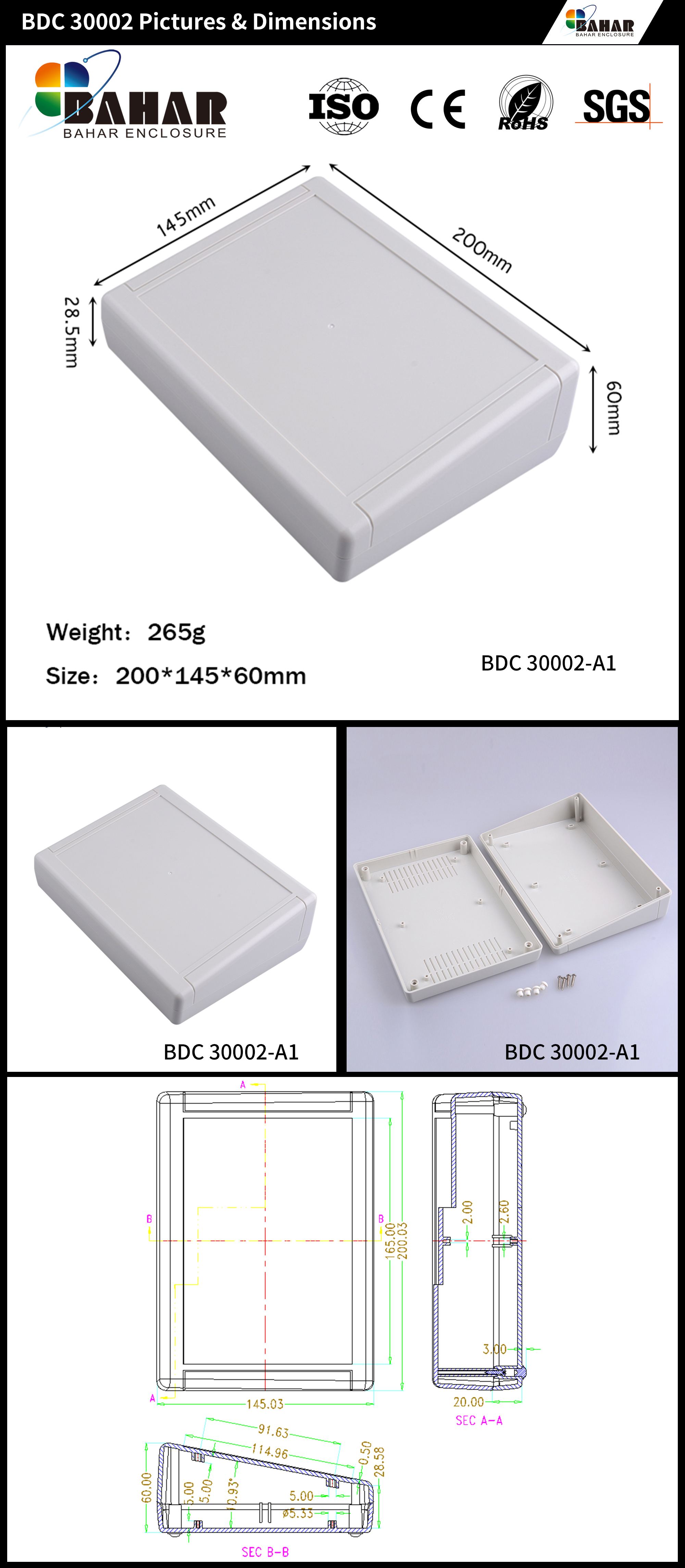
BDC 30002|200 × 145 × 63 mm

Durable enclosure designed for industrial and electronic desktop applications.
|
🧱 Material
ABS Plastic
|
🌡️ Temperature
-30°C to +85°C
|
|
💧 Protection
IP54 Rated
|
🎨 Color
Off-white
|
| Application | Junction boxes, control boxes, electrical boxes |
| Size | 200 × 145 × 60 mm |
| Weight | 265 g |
| Material | ABS |
| Color | Off-white |
| Protection | IP54 |
| Certificates | ABS, SGS |
Modern industrial equipment requires more than reliable electronics. Engineers must also consider protection, usability, maintenance accessibility and product appearance. Selecting the right enclosure is therefore a critical step during product development. The BDC 30002 Industrial Control Housing provides a practical solution for electronic devices that require a professional desktop-style enclosure with sufficient internal space for control electronics, displays and communication interfaces.
As industrial automation continues to expand, equipment manufacturers need enclosure solutions that support long-term reliability while maintaining a clean and professional appearance. The Industrial Control Housing concept has become increasingly important because electronic systems now play a central role in production facilities, laboratories, monitoring stations and intelligent infrastructure projects.
Many product developers begin their enclosure selection process by reviewing the Desktop Enclosure Collection to compare housing dimensions, panel configurations and installation options before making a final decision.
A properly selected Industrial Control Housing can improve serviceability, simplify assembly procedures and provide an ergonomic platform for displays, indicators and operator controls. These advantages help manufacturers create products that are easier to use and maintain throughout their operational lifecycle.
Electronic equipment is often expected to operate continuously for years. During this time, devices may experience vibration, temperature fluctuations and repeated interaction from operators. A dependable Industrial Control Housing helps support these conditions by providing mechanical protection and a stable platform for internal components.
Industrial organizations rely on control systems to manage production processes, monitor equipment status and optimize operational efficiency. These systems frequently require displays, communication ports and configuration interfaces that must remain accessible during daily operation.
A desktop-style Industrial Control Housing supports these requirements by allowing devices to be positioned conveniently on workstations, operator desks and laboratory benches. This design approach improves accessibility while maintaining a compact installation footprint.
Manufacturers developing operator-facing products often evaluate both the Desktop Enclosure Series and the Wall Mounting Enclosure Collection when determining the most appropriate installation strategy for a project.
Automation technologies continue to transform industrial operations throughout the world. Production facilities increasingly depend on intelligent control systems capable of managing equipment, collecting information and improving operational efficiency. As these systems become more advanced, enclosure selection becomes a critical engineering decision.
An Industrial Control Housing serves as the foundation for automation equipment by protecting electronic assemblies while providing convenient access to displays, indicators and communication interfaces. The enclosure is often the first component customers see, making both functionality and appearance important considerations.
Modern automation equipment may include programmable controllers, communication gateways, monitoring interfaces and data acquisition devices. These products require a housing solution capable of supporting long-term operation while maintaining a professional appearance.
Many manufacturers developing automation equipment review products from the Desktop Enclosure Collection because desktop-style housings provide convenient access to operator controls and display systems.
A well-designed Industrial Control Housing helps simplify maintenance activities. Engineers and technicians can access internal components more efficiently, reducing service time and improving equipment availability.
Organizations implementing factory automation projects frequently combine desktop equipment with products from the DIN Rail Enclosure Series. This combination creates a structured architecture where operator interfaces, communication modules and control electronics work together seamlessly.
As industrial networks continue to expand, communication between equipment becomes increasingly important. Reliable enclosure solutions help support these technologies by protecting internal electronics and maintaining system reliability.
The growing adoption of Industrial IoT technologies has further increased demand for dependable automation equipment. Devices must not only process information but also communicate with cloud platforms, monitoring software and enterprise management systems.
For these applications, an Industrial Control Housing provides the mechanical platform required to support displays, indicators, communication ports and user controls while maintaining a clean and professional appearance.
Many OEM manufacturers use standardized enclosure platforms across multiple products because this approach reduces engineering costs and simplifies production planning.
Process monitoring has become an essential component of modern industrial operations. Manufacturing facilities rely on accurate information to improve efficiency, reduce downtime and maintain product quality. Monitoring systems collect data from sensors, controllers and communication devices before presenting information to operators.
An Industrial Control Housing provides a practical enclosure solution for monitoring equipment because it combines protection, accessibility and professional appearance. Operators can easily access displays and control interfaces while sensitive electronics remain protected inside the enclosure.
Industrial monitoring equipment is commonly used in manufacturing, energy management, transportation, water treatment and building automation applications. These systems often operate continuously and require reliable housing solutions capable of supporting long-term use.
Engineers developing monitoring terminals frequently compare products from the Wall Mounting Enclosure Collection and desktop enclosure families to determine the most suitable installation method.
Many monitoring systems include communication capabilities that allow information to be transmitted to centralized management platforms. As connectivity requirements increase, enclosure design must support additional interfaces and electronic components.
A professional Industrial Control Housing helps manufacturers create products that are both functional and visually appealing. Customers often associate enclosure quality with overall product quality, making enclosure selection an important commercial decision.
Organizations installing remote monitoring systems may use products from the Waterproof Enclosure Collection for field devices while utilizing desktop control equipment within control rooms and operator stations.
As industrial facilities continue to invest in digital transformation initiatives, demand for monitoring equipment is expected to grow. Reliable enclosure platforms help support this trend by providing dependable mechanical protection and professional product presentation.
OEM manufacturers face increasing pressure to deliver innovative products while controlling development costs and reducing time-to-market. One effective strategy involves the use of proven enclosure platforms that can support multiple products across an entire portfolio.
A standardized Industrial Control Housing enables engineering teams to focus on electronic functionality and software development rather than investing resources into custom mechanical designs for every project.
Using a common enclosure family can improve inventory management, simplify procurement activities and reduce manufacturing complexity. These advantages become particularly valuable as product portfolios continue to expand.
Many commercial electronic products require display windows, communication connectors, membrane keypads and branding elements. Rather than designing a new enclosure from the ground up, manufacturers can often adapt an existing Industrial Control Housing to meet these requirements.
Customization services available through the Customization Center allow manufacturers to add machining, printing, connector openings and other project-specific modifications while retaining the benefits of a proven enclosure platform.
Engineering teams often review resources available through the Downloads Center when evaluating enclosure compatibility with their products. Access to technical information can significantly reduce development risks and accelerate project timelines.
Additional design guidance is available through the Engineering Blog, which contains enclosure selection advice, product development insights and application examples.
The ability to adapt a proven Industrial Control Housing to multiple applications makes it an attractive choice for OEM manufacturers operating in competitive markets.
Technology continues to evolve rapidly. Products that are competitive today may require new features tomorrow. For this reason, manufacturers increasingly seek enclosure solutions that can support future upgrades and product expansion.
A flexible Industrial Control Housing provides the foundation required for future product generations. Additional communication modules, upgraded displays and enhanced processing capabilities can often be integrated without changing the overall enclosure platform.
Many companies create complete product ecosystems that include operator interfaces, monitoring systems, communication gateways and distributed control devices. Selecting enclosure families that work together can simplify system design while improving visual consistency.
Engineers frequently review the Complete Product Catalog to identify enclosure solutions suitable for future development projects and long-term product strategies.
Organizations seeking technical assistance can obtain information through the FAQ Center, learn more about Bahar through the About Us Page or discuss project requirements directly through the Contact Page.
Products built using an Industrial Control Housing are often developed according to internationally recognized engineering practices and references such as ISO Standards, IEC Standards, UL Certification, RoHS Compliance and CE Marking.
As automation, connectivity and intelligent control technologies continue to expand, demand for professional enclosure solutions will remain strong. A dependable Industrial Control Housing helps manufacturers create products that are reliable, serviceable and ready for future technological developments.
Communication technology has become a fundamental part of modern industrial infrastructure. Production facilities, energy systems, transportation networks and commercial buildings all rely on electronic devices that exchange information continuously. These devices require dependable enclosure solutions capable of supporting long-term operation while maintaining a professional appearance.
An Industrial Control Housing is frequently used for communication interfaces, network monitoring terminals, protocol converters and gateway devices. These products often include displays, indicators and configuration controls that must remain accessible throughout daily operation.
As industrial communication systems continue to evolve, manufacturers seek enclosure platforms that can support future hardware upgrades without requiring major mechanical redesigns. A flexible Industrial Control Housing helps simplify this process while improving product consistency across multiple generations.
Many organizations combine communication equipment with products from the DIN Rail Enclosure Collection to create integrated control architectures capable of supporting advanced industrial automation projects.
Reliable communication infrastructure is essential for Industry 4.0 initiatives. Devices responsible for collecting, processing and distributing information require enclosure solutions that support both functionality and long-term durability.
Measurement equipment continues to play a critical role across a wide range of industries. Engineers depend on accurate information when evaluating performance, troubleshooting systems and optimizing production processes.
A professional Industrial Control Housing provides an effective platform for electronic measurement devices by supporting displays, indicators and user controls while protecting sensitive internal assemblies.
Laboratory instruments, calibration equipment and testing devices frequently require desktop-style housings because operators interact directly with the equipment throughout the day. Convenient access to displays and controls improves usability while supporting efficient operation.
Many manufacturers developing measurement products evaluate solutions from the Desktop Enclosure Series because these products provide practical layouts for display-oriented equipment.
The ability to integrate connectors, switches, communication interfaces and display modules makes an Industrial Control Housing an attractive choice for modern electronic instrumentation.
Building automation systems are becoming increasingly sophisticated as organizations seek greater efficiency, improved sustainability and enhanced operational visibility. Electronic devices used in these systems often monitor temperature, energy consumption, security systems and environmental conditions.
A dependable Industrial Control Housing supports these applications by providing a stable platform for displays, indicators and communication interfaces. Building operators rely on accurate information and intuitive controls to manage increasingly complex systems.
Many building automation projects incorporate a combination of wall-mounted equipment, control cabinets and operator terminals. Products from the Wall Mounting Enclosure Collection are frequently used alongside desktop devices to create complete system architectures.
The ability to maintain a consistent enclosure design language across multiple products helps improve both appearance and user familiarity. This can simplify training requirements while strengthening overall product identity.
As smart building technologies continue to expand, demand for reliable enclosure solutions will continue to increase across commercial, industrial and institutional applications.
Long-term reliability remains one of the most important considerations during electronic product development. Customers expect equipment to operate consistently for years while requiring minimal maintenance.
A well-designed Industrial Control Housing contributes to reliability by protecting internal electronics from accidental impacts, contamination and unnecessary handling. While enclosure selection represents only one aspect of product design, it plays a significant role in overall product durability.
Manufacturers investing in dependable enclosure platforms often benefit from reduced warranty costs, improved customer satisfaction and stronger market reputation. These advantages become increasingly important as competition continues to intensify across industrial markets.
Organizations developing commercial electronic products frequently review technical resources available through the Downloads Center before selecting enclosure solutions for long-term projects.
Additional application guidance can be found within the Engineering Blog, where enclosure selection strategies and industry-specific recommendations are discussed in greater detail.
Manufacturers seeking a balance between usability, durability and professional appearance often choose an Industrial Control Housing as the foundation for monitoring systems, communication devices, testing instruments and industrial control equipment.
Human Machine Interface systems continue to play a central role in industrial environments. Operators rely on HMI equipment to access information, configure equipment settings and monitor production processes in real time.
An Industrial Control Housing is particularly well suited for HMI applications because it provides sufficient space for displays, indicators and operator controls while maintaining an ergonomic desktop form factor.
Modern HMI devices frequently incorporate touchscreen technology, communication modules and advanced software capabilities. These developments require enclosure solutions capable of supporting both current requirements and future upgrades.
The flexibility of an Industrial Control Housing enables manufacturers to develop multiple product variations while maintaining a consistent mechanical platform. This approach can simplify production planning and reduce engineering costs.
Companies building comprehensive automation systems often combine desktop HMI equipment with products from the DIN Rail Enclosure Series and the Wall Mounting Enclosure Collection to create complete industrial solutions.
As automation technologies continue to evolve, demand for professional operator interface equipment is expected to increase. Reliable enclosure platforms help support this growth by providing a dependable foundation for electronic product development.
Industrial IoT technology continues to reshape modern manufacturing environments. Machines, sensors, controllers and communication devices are increasingly connected to centralized software platforms capable of collecting and analyzing operational data. These systems improve efficiency, reduce downtime and support predictive maintenance strategies.
An Industrial Control Housing provides an ideal platform for IoT gateways, monitoring terminals and edge computing devices because it combines professional appearance with practical functionality. Electronic assemblies can be organized efficiently while maintaining convenient access for operators and maintenance personnel.
Many IoT deployments involve a combination of field devices, communication infrastructure and centralized monitoring equipment. Products from the Waterproof Enclosure Collection are frequently used for outdoor equipment while desktop solutions support operator-facing devices.
The increasing volume of operational data generated by industrial facilities requires reliable hardware platforms capable of presenting information clearly and accurately. A dependable Industrial Control Housing helps support these objectives while improving overall product quality.
As digital transformation initiatives continue to accelerate, manufacturers increasingly seek enclosure solutions that can support future communication technologies and system expansion requirements.
Energy management has become a strategic priority for organizations seeking to reduce costs and improve sustainability. Modern facilities rely on electronic monitoring systems that track power consumption, equipment performance and environmental conditions in real time.
An Industrial Control Housing is commonly used for energy monitoring terminals because operators require convenient access to displays, indicators and reporting functions. Desktop-style equipment remains popular in these applications due to its ergonomic layout and professional appearance.
Energy monitoring systems often communicate with controllers, sensors and distributed devices located throughout a facility. For these applications, engineers frequently combine desktop monitoring products with solutions from the DIN Rail Enclosure Collection.
Reliable enclosure platforms help support the long-term operation of energy management systems by providing a stable environment for electronic assemblies while maintaining accessibility for users.
Organizations implementing energy efficiency initiatives often invest in monitoring technologies that remain operational for many years. Selecting a dependable Industrial Control Housing can therefore contribute to long-term project success.
Electronic product manufacturers continually balance performance, cost and development speed when bringing new products to market. Enclosure selection can significantly influence each of these factors.
A proven Industrial Control Housing allows manufacturers to reduce mechanical development effort while maintaining a professional product appearance. This strategy enables engineering teams to focus on innovation rather than reinventing enclosure designs for every project.
Many successful manufacturers standardize enclosure platforms across multiple product families. This approach simplifies inventory management, reduces tooling requirements and improves manufacturing consistency.
Companies developing custom electronic products often utilize services available through the Customization Center to add display openings, connector cutouts, branding elements and application-specific features.
The ability to customize a standard Industrial Control Housing while preserving its core advantages makes this approach attractive for OEM and ODM product development projects.
Manufacturers can also explore the Complete Product Catalog to identify enclosure families suitable for future product expansion and long-term development strategies.
Technology evolves rapidly, and products that are successful today often require upgrades tomorrow. Manufacturers therefore seek enclosure platforms capable of supporting future hardware improvements without extensive mechanical redesign.
A scalable Industrial Control Housing provides flexibility for future product generations. Additional communication capabilities, enhanced displays and upgraded processing hardware can often be integrated while maintaining a consistent product identity.
This continuity benefits both manufacturers and customers. Engineering teams reduce development effort while users become familiar with a consistent product appearance and operating experience.
Additional engineering resources are available through the Engineering Blog, while technical drawings and product documentation can be accessed through the Downloads Center.
Organizations requiring direct assistance can contact the Bahar team through the Contact Page for enclosure selection guidance, customization support and technical consultation.
Products based on an Industrial Control Housing are frequently developed in accordance with recognized engineering practices and references such as ISO Standards, IEC Standards, UL Certification, RoHS Compliance and CE Marking.
As industrial automation, connectivity and intelligent monitoring technologies continue to expand, the demand for professional enclosure solutions will remain strong. A reliable Industrial Control Housing provides the foundation required for innovative products capable of meeting both current and future market expectations.




BMD 60001 | 80 × 50 × 19 mm

BMD 60002 | 95 × 55 × 23 mm

BMD 60003 | 110 × 65 × 28 mm
