Professional Enclosure Manufacturer | Custom Solutions
Incoterms for Shipping are among the most important rules buyers and sellers need to understand before arranging an international shipment. Choosing the wrong shipping term can lead to unexpected freight charges, customs costs, insurance issues, delays, or misunderstandings about who is responsible for the goods during transportation.
Whether you are importing waterproof electrical enclosures, industrial components, machinery, electronics, or other products from China, understanding Incoterms can help you compare quotations correctly and calculate your real landed cost before placing an order.
In this guide, we explain the most commonly used Incoterms for Shipping, including EXW, FCA, FOB, CFR, CIF, CPT, CIP, DAP, DPU and DDP. You will also learn when responsibility and risk transfer from the seller to the buyer and which shipping term may be more suitable for your project.
Incoterms, short for International Commercial Terms, are internationally recognized trade rules published by the International Chamber of Commerce. They are designed to clarify the responsibilities, costs and risks between buyers and sellers when goods are delivered.
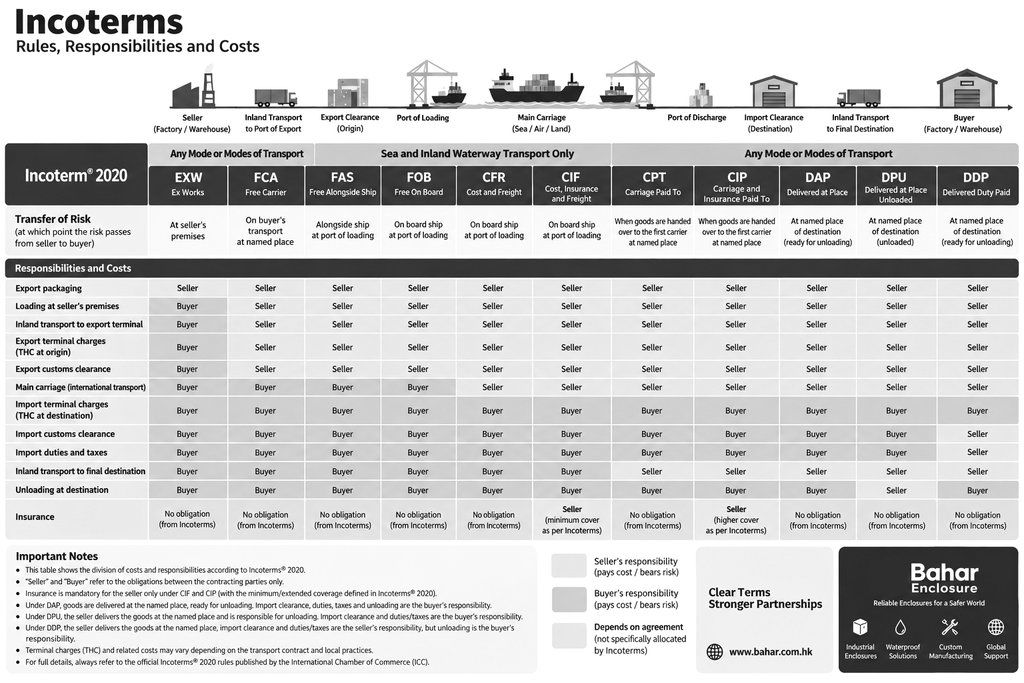
The current version is Incoterms 2020. It contains 11 trade rules. Seven can be used with any mode of transportation, while four are intended specifically for sea and inland waterway transportation.
According to the International Chamber of Commerce, Incoterms help define which party is responsible for transportation, export procedures, import procedures, insurance, delivery and risk at different stages of a transaction.
For the official rules and latest guidance, visit the International Chamber of Commerce Incoterms® resource.
A product price alone does not tell you how much an international order will finally cost. Two suppliers may quote exactly the same product price while using different Incoterms, resulting in very different transportation and import expenses.
For example, an EXW quotation may initially look cheaper because the supplier’s responsibility generally ends at the agreed factory or warehouse location. The buyer then has to arrange many parts of the transportation process.
With DAP, on the other hand, the seller normally arranges transportation to the named destination, while the buyer remains responsible for import clearance, duties and taxes.
This is why buyers should always check the Incoterm together with the product price before comparing suppliers.
There are currently 11 Incoterms 2020 rules.
The ICC specifically separates these two groups because FOB, FAS, CFR and CIF are intended for sea or inland waterway transport, while EXW, FCA, CPT, CIP, DAP, DPU and DDP may be used with different transport modes.
| Incoterm | Seller Arranges Main Freight? | Insurance Required from Seller? | Import Customs | Common Use |
|---|---|---|---|---|
| EXW | No | No | Buyer | Factory pickup |
| FCA | Usually No | No | Buyer | Air, road, sea, multimodal |
| FOB | To loading port | No | Buyer | Sea freight |
| CFR | Yes | No | Buyer | Sea freight |
| CIF | Yes | Yes | Buyer | Sea freight |
| CPT | Yes | No | Buyer | Any transport mode |
| CIP | Yes | Yes | Buyer | Any transport mode |
| DAP | Yes | Not automatically required | Buyer | Door or named destination |
| DPU | Yes | Not automatically required | Buyer | Delivered and unloaded |
| DDP | Yes | Not automatically required | Seller | Maximum seller responsibility |
EXW is one of the simplest Incoterms from the seller’s perspective. Under Ex Works, the seller makes the goods available to the buyer at the agreed location, such as the seller’s factory or warehouse.
The buyer normally arranges collection, export transportation, international freight, customs procedures and import delivery.
Under the ICC description of EXW, the seller is not required to load the goods onto the collecting vehicle or complete export clearance unless separately agreed. This is one reason international buyers should examine EXW carefully before using it.
EXW may be suitable when the buyer already has a trusted freight forwarder or logistics partner in the seller’s country and prefers complete control over transportation.
For experienced importers purchasing from China, EXW can provide flexibility because the buyer can negotiate directly with the freight forwarder.
Depending on the exact shipment arrangement, the buyer may need to organize pickup, export handling, international transportation, insurance, import customs clearance, duties, taxes and final delivery.
FCA stands for Free Carrier. It can be used for road freight, air freight, rail freight, sea freight and multimodal transportation.
Under FCA, the seller delivers the goods to the carrier or another party nominated by the buyer at the agreed location.
FCA can be especially useful for containerized shipments because it clearly identifies the point where the goods are handed over to the carrier.
If the named delivery location is the seller’s premises, the seller generally delivers the goods when they are loaded onto the buyer’s nominated transportation. If another place is named, delivery conditions are different, so the exact named location should always appear in the sales contract.
FOB is one of the most commonly recognized shipping terms in international trade.
FOB stands for Free On Board and is designed specifically for sea and inland waterway transportation.
Under FOB, the seller is responsible for delivering the goods on board the vessel at the named port of shipment. Once the goods are on board, the risk transfers to the buyer.
The buyer normally pays for the main ocean freight, insurance if required, destination charges, import customs clearance, duties, taxes and inland delivery.
If the sales contract states:
FOB Shenzhen, Incoterms 2020
the seller is responsible for the shipment until the goods are delivered on board the vessel at the agreed Shenzhen port.
CFR stands for Cost and Freight and is also intended only for sea and inland waterway transportation.
With CFR, the seller arranges and pays the ocean freight to the named destination port.
However, an important detail is that the transfer of risk does not occur at the destination port. According to the ICC rules, risk transfers when the goods are placed on board the vessel at the port of shipment.
This means the seller may pay the freight to the destination while the buyer bears the transportation risk after the agreed delivery point.
CFR does not require the seller to purchase insurance for the buyer.
CIF is similar to CFR but includes seller-arranged insurance.
The seller is responsible for the cost of transporting the goods to the named destination port and also obtains the insurance cover required under the CIF rule.
CIF is commonly used for traditional maritime shipments.
However, buyers should still understand that the point where transportation costs are paid to and the point where risk transfers are not necessarily the same.
CPT stands for Carriage Paid To and can be used for any mode of transportation.
Under CPT, the seller pays for transportation to the named destination.
However, risk generally transfers earlier when the goods are delivered to the carrier, rather than when they physically arrive at the final destination.
This difference between cost responsibility and risk responsibility is extremely important when using Incoterms for Shipping.
CIP stands for Carriage and Insurance Paid To.
It works similarly to CPT, but the seller must also arrange cargo insurance according to the requirements of the CIP rule.
CIP may be useful for valuable industrial products, electronics, machines or other goods where the buyer wants seller-arranged transportation together with insurance protection.
DAP stands for Delivered at Place and is particularly important for international buyers purchasing products directly from overseas suppliers.
Under DAP, the seller arranges transportation to the agreed named destination and makes the goods available to the buyer ready for unloading.
The buyer normally remains responsible for import customs clearance, import duties, VAT or other local taxes.
A customer purchasing industrial enclosures from Bahar Enclosure may choose a DAP quotation when they prefer us to organize international transportation to the agreed destination.
For example:
DAP customer’s address, Incoterms 2020
The transportation may be arranged to the agreed destination, but the buyer remains responsible for local import clearance, customs duties, import taxes and other charges imposed by the destination country.
This distinction should be understood before payment because DAP does not automatically mean that all destination-country taxes are included.
DPU means Delivered at Place Unloaded.
DPU is similar to DAP, but the major difference is unloading.
Under DAP, the goods are delivered ready for unloading. Under DPU, the seller is also responsible for unloading the goods at the named destination.
DPU is the only Incoterms 2020 rule where the seller’s delivery obligation specifically includes unloading at the named destination.
DDP stands for Delivered Duty Paid and represents one of the highest levels of seller responsibility under the Incoterms rules.
Under DDP, the seller generally arranges transportation and handles export and import clearance while also being responsible for applicable import duties and taxes according to the agreed transaction.
For buyers, DDP may appear convenient because the seller handles most of the logistics process.
However, DDP can be difficult in some countries because foreign sellers may not be legally or practically able to complete import customs formalities or pay domestic taxes in the buyer’s country.
For this reason, DDP should only be quoted after checking the customs and tax requirements of the destination country.
FAS stands for Free Alongside Ship and applies only to sea or inland waterway transportation.
The seller delivers the goods alongside the nominated vessel at the named port of shipment.
After delivery alongside the ship, the buyer takes responsibility for the main transportation and related risk.
FAS is often associated with bulk cargo or non-containerized shipments rather than typical small industrial product orders.
There is no single shipping term that is best for every buyer.
The right Incoterm depends on the buyer’s experience, destination, shipment size, freight forwarder relationships and preference for logistics control.
For a first-time importer, DAP may be easier because the supplier can arrange transportation to the destination while the buyer manages local import customs requirements.
For experienced importers with their own freight forwarders in China, EXW or FCA may provide more control.
For traditional ocean freight shipments, FOB remains widely used, although FCA may be more appropriate in certain containerized transportation arrangements.
EXW and FOB are both frequently requested by international buyers, but they create very different responsibilities.
With EXW, the buyer generally takes responsibility very early, starting from the seller’s named location.
With FOB, the seller handles more of the export-side process and delivers the goods on board the vessel at the named shipment port.
Therefore, a FOB price will normally be higher than an EXW product price because additional export and local transportation costs may be included.
Under FOB, the buyer typically arranges the main international ocean freight.
Under CIF, the seller arranges and pays for the ocean freight and provides the required insurance to the named destination port.
Buyers should not compare FOB and CIF quotations using only the unit product price because their included logistics services are different.
DAP and DDP are often confused because both can involve delivery close to or directly to the buyer’s destination.
The main difference is import clearance and import taxes.
Under DAP, the buyer normally handles import customs clearance and pays customs duties and taxes.
Under DDP, these import responsibilities generally belong to the seller.
For many international B2B transactions, DAP can be more practical because the buyer is often better positioned to handle customs formalities in their own country.
CIF is designed specifically for sea or inland waterway shipping and normally covers transportation to a destination port together with insurance.
DAP can be used with multiple transportation modes and may cover transportation to a named place beyond the port, including the buyer’s warehouse or another agreed destination.
This makes DAP particularly useful for courier, air freight and multimodal shipments.
The answer depends on the selected Incoterm.
For most commonly used Incoterms such as EXW, FCA, FOB, CFR, CIF, CPT, CIP, DAP and DPU, import customs clearance and import duties are generally the buyer’s responsibility.
DDP is the major exception, where the seller takes responsibility for import customs formalities and applicable import duties under the agreed term.
Always specify the destination and exact version of the Incoterm in your purchase agreement.
Shipping cost responsibility depends on the Incoterm selected.
Under EXW, the buyer generally arranges most transportation.
Under FOB, the seller handles transportation and export requirements up to the agreed loading point while the buyer arranges the main freight.
Under CIF, CFR, CPT and CIP, the seller pays for specified main transportation even though the risk may transfer earlier.
Under DAP and DDP, the seller arranges transportation to the named destination.
Only certain Incoterms specifically require seller-arranged insurance.
CIF and CIP include insurance obligations for the seller.
Other Incoterms do not automatically require the seller to insure the shipment for the buyer.
Nevertheless, either party may separately arrange cargo insurance depending on the shipment value and agreed contract.
One common mistake is comparing supplier prices without checking which shipping term is included.
Another mistake is assuming DAP means customs duties are already paid.
Buyers also sometimes use FOB for every type of international shipment, even when their goods move mainly by courier, air freight or containerized multimodal transport.
Another important mistake is failing to include the exact named place.
For example, writing simply “DAP” is incomplete. A better commercial document might state:
DAP Berlin, Germany – Incoterms 2020
or:
FOB Shenzhen Port, China – Incoterms 2020
Incoterms are important, but they do not replace a complete purchase agreement.
They do not by themselves define product quality, payment method, warranty conditions, product specifications, intellectual property rights, dispute resolution or when ownership of the goods legally transfers.
These matters should be defined separately between the seller and buyer.
When purchasing industrial and waterproof enclosures internationally, the shipping term should be selected according to the size and value of the order.
A small sample shipment may be sent by express courier under a destination-based arrangement.
A medium-size production order may move by air freight or multimodal freight.
A large-volume order can potentially be shipped by ocean freight under terms such as FCA, FOB, CFR or CIF depending on the logistics arrangement.
At Bahar Enclosure, customers can discuss the most practical transportation option based on product quantity, carton dimensions, shipment weight and destination.
Bahar Enclosure manufactures a wide range of industrial enclosure products including IP-rated plastic electrical boxes.
You can explore our:
If waterproof protection is important for your project, you may also find these guides useful:
Before confirming an order, ask the supplier to clearly state the Incoterm and named place on the quotation or proforma invoice.
You should also check whether the freight quotation includes pickup, export customs handling, origin charges, international transportation, insurance, destination delivery, customs brokerage, import duty and local tax.
This makes it easier to calculate your real landed cost.
Common terms include EXW, FCA, FOB, CIF, CPT, DAP and DDP. The best choice depends on the shipment method, destination and how much responsibility each party wants to manage.
DAP can be convenient for many international buyers because the seller arranges transportation to the named destination. However, the buyer normally remains responsible for import clearance, duties and taxes.
No Incoterm is automatically the cheapest. EXW may show the lowest supplier quotation, but the buyer must then pay many transportation and handling costs separately.
Normally no. Under DAP, import customs clearance, duties and taxes are generally the buyer’s responsibility.
DDP generally places responsibility for import clearance and import duties on the seller, subject to local customs and tax laws.
Yes. CIF includes a seller obligation to arrange the required cargo insurance under that Incoterm.
FOB includes the seller’s obligations up to delivery on board the nominated vessel at the shipment port. The buyer generally pays the main ocean freight after that point.
FOB is intended for sea and inland waterway transport. FCA is usually more appropriate for air freight and many multimodal shipments.
DAP means the goods are delivered ready for unloading. Under DPU, the seller is responsible for unloading the goods at the named destination.
Experienced buyers with their own logistics providers may prefer EXW or FCA. Buyers who want the supplier to arrange transportation may prefer DAP. For sea shipments, FOB, CFR or CIF may also be considered depending on the arrangement.
Understanding Incoterms for Shipping is essential when purchasing products internationally. The selected Incoterm affects transportation costs, customs responsibilities, insurance and the point at which shipment risk transfers between seller and buyer.
Before comparing quotations, always check whether the supplier is offering EXW, FCA, FOB, CIF, DAP, DDP or another Incoterm.
For industrial enclosure orders from Bahar Enclosure, our team can help customers evaluate the available shipping options based on order quantity, destination and shipment requirements.
Explore our waterproof enclosure range or contact Bahar Enclosure for product and shipping information for your next international project.