Professional Enclosure Manufacturer | Custom Solutions
Home > Aluminum Enclosure> BAD 110 Series Aluminum Enclosure> BAD 11001 Series Aluminum Enclosure > BAD 11001(W140)-Aluminum Enclosure

Designed for electronic instruments, precision measurement equipment, laboratory devices, industrial instrumentation, desktop controllers, embedded electronic systems, calibration instruments, testing equipment, data acquisition units and OEM instrument enclosure applications.
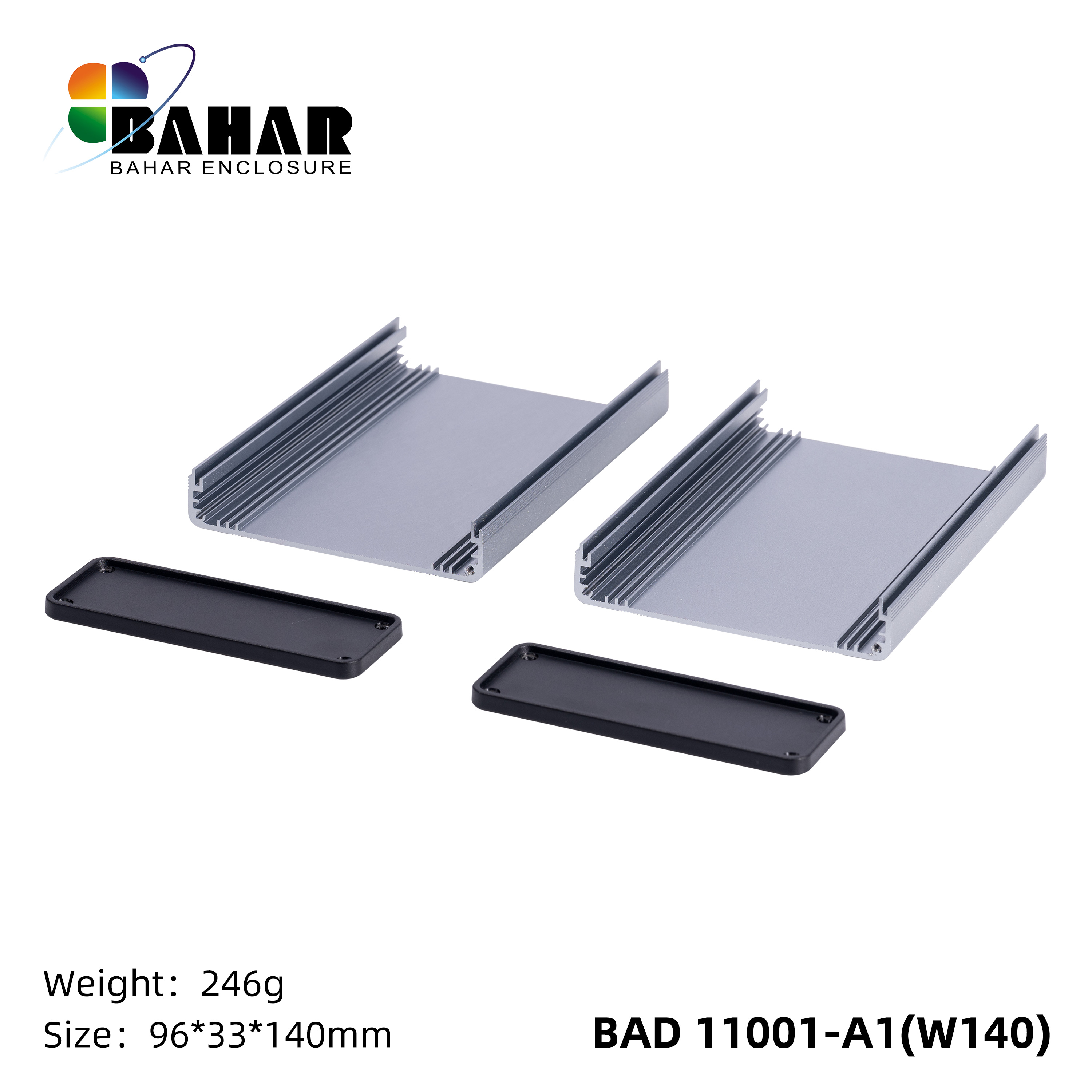
BAD 11001(W140)|140 × 96 × 33 mm
Compact desktop aluminum enclosure designed for DIY electronics, control systems, instrument devices, compact power supply equipment, and embedded industrial applications.
|
🧱 Material
Aluminum Housing + ABS Base
|
⚙️ Surface Finish
Sandblasting & Oxidation
|
|
🎨 Available Color
Gray
|
🌡️ Operating Temperature
-45°C to 85°C
|
| Dimensions | 140 × 96 × 33 mm |
| Weight | 0.30 KG |
| Main Structure | Durable aluminum body with high-quality ABS base for stable desktop usage. |
| Surface Treatment | Professional sandblasting and anodized oxidation finish for improved durability, corrosion resistance, and premium appearance. |
| Installation Style | Desktop-style compact enclosure with stable base structure. |
| Available Color | Gray |
| Advantages | Compact lightweight structure, modern industrial appearance, excellent heat dissipation, durable construction, and manufactured using premium imported raw materials. |
Every professional measuring instrument begins with reliable mechanical protection. Whether engineers are developing laboratory equipment, industrial controllers, electronic analyzers or embedded testing devices, the enclosure directly affects durability, thermal performance and user experience. A high-quality Instrument Enclosure is more than an external shell—it becomes part of the product itself by protecting electronics while presenting a professional appearance suitable for commercial and industrial environments.
The BAD 11001 Instrument Enclosure combines an anodized aluminum body with durable ABS end panels to create a lightweight yet rigid housing for compact electronic instruments. Its desktop-oriented design provides an excellent platform for OEM manufacturers building portable measuring equipment, control interfaces, signal analyzers and embedded electronic systems where appearance and reliability are equally important.
Unlike plastic housings that focus primarily on electrical insulation, aluminum offers additional engineering advantages that benefit professional electronic products. The rigid metal structure improves mechanical stability, resists deformation during transportation and provides a premium appearance expected from commercial instrumentation.
For manufacturers developing long-life electronic equipment, an Instrument Enclosure manufactured from aluminum also provides improved dimensional stability, making it suitable for products that must maintain accurate mechanical alignment throughout years of operation.
Customers often evaluate engineering quality long before testing electronic performance. Surface finish, material selection, machining precision and overall industrial design create an immediate impression that influences purchasing decisions. Professional instruments used in laboratories, automation systems and technical environments are expected to demonstrate both functional reliability and premium construction.
The anodized finish of the BAD 11001 Instrument Enclosure provides a clean industrial appearance suitable for OEM equipment intended for commercial distribution or professional applications.
Desktop electronic equipment is handled differently from permanently installed industrial devices. Engineers frequently reposition laboratory instruments, connect temporary cables, replace modules and perform repeated testing during product development. A compact Instrument Enclosure designed for desktop operation improves accessibility while maintaining mechanical protection for internal electronics.
Its stable desktop configuration makes the enclosure suitable for benchtop applications where usability is just as important as environmental protection.
Every electronic instrument requires its own interface layout. Some products integrate LCD displays, membrane keypads, rotary encoders, communication ports or specialized connectors. Bahar provides complete OEM enclosure customization, including CNC machining, display openings, connector cut-outs, laser engraving, UV printing and silk-screen printing according to customer engineering drawings.
Manufacturers developing complete instrument product lines can also integrate additional models from the Aluminum Enclosure Series, allowing different product sizes to maintain a consistent industrial design language while simplifying manufacturing and inventory management.
Organizations such as the National Instruments community continue demonstrating the importance of robust mechanical design in modern electronic instrumentation. By combining a precision aluminum housing, durable ABS end panels, professional anodized finishing and comprehensive OEM customization services, the BAD 11001 Instrument Enclosure provides engineers with a dependable mechanical platform for developing next-generation electronic instruments and control equipment.
Electronic equipment is ultimately built for people. Whether an instrument is used by a laboratory technician, a maintenance engineer or a production operator, every interaction with the device influences productivity and user confidence. While software interfaces often receive the most attention, the physical design of an Instrument Enclosure plays an equally important role in creating a comfortable and efficient user experience.
The BAD 11001 Instrument Enclosure is designed for desktop electronic equipment that operators use frequently throughout the working day. Its compact dimensions, stable structure and professional appearance make it suitable for products that require both technical performance and ergonomic usability.
Control instruments are often used continuously for configuration, monitoring, testing and diagnostics. If an enclosure is difficult to position, unstable on a workbench or awkward to access, even simple daily operations become inefficient. A well-designed desktop Instrument Enclosure helps engineers create products that remain comfortable during extended use while improving workflow in laboratories, service centers and industrial environments.
Many operating mistakes are caused by poor mechanical organization rather than electronic failure. Clearly accessible connectors, logical cable routing and a stable enclosure reduce unnecessary handling and make routine operation more intuitive. Product designers increasingly recognize that mechanical simplicity contributes directly to safer and more efficient equipment.
The BAD 11001 Instrument Enclosure provides a balanced mechanical platform that supports organized front and rear panel layouts, making it easier for OEM manufacturers to develop user-friendly electronic products.
Industrial customers frequently associate mechanical quality with engineering quality. A durable anodized aluminum housing immediately communicates precision, reliability and long-term durability before the instrument is even switched on. This first impression is especially important for commercial products sold into laboratories, automation facilities and professional technical markets.
Every electronic instrument has unique interface requirements. Bahar offers complete OEM enclosure customization, including CNC machining, display windows, connector openings, laser engraving, silk-screen printing and UV printing according to customer CAD drawings. These manufacturing services allow OEM companies to create instruments that combine professional appearance with efficient production.
Manufacturers developing multiple product sizes can also utilize additional models from the Aluminum Enclosure Series, ensuring a consistent industrial design across their complete product portfolio.
The Interaction Design Foundation emphasizes that successful products combine usability, functionality and thoughtful physical design. By integrating a rigid aluminum body, precision manufacturing and flexible OEM customization, the BAD 11001 Instrument Enclosure provides an ideal foundation for desktop electronic instruments that are not only reliable but also comfortable and intuitive to operate.
When purchasing electronic equipment, many buyers focus primarily on the initial product cost. However, experienced OEM manufacturers evaluate products differently. They consider the Total Cost of Ownership (TCO), which includes maintenance, repairs, product lifespan, manufacturing efficiency and future upgrade capability. A well-designed Instrument Enclosure contributes to lowering these long-term costs by providing a durable mechanical platform that supports reliable operation throughout the entire product lifecycle.
The BAD 11001 Instrument Enclosure is engineered to provide a balance between lightweight construction, mechanical strength and professional appearance. Its aluminum housing helps manufacturers build desktop electronic products that remain dependable in laboratories, industrial control rooms and commercial environments for many years.
Replacing damaged equipment often costs far more than the original enclosure itself. Production downtime, technician labor, logistics and equipment recalibration all increase operational expenses. Selecting a durable Instrument Enclosure during the product development stage helps manufacturers reduce these hidden lifecycle costs while improving customer satisfaction.
Many OEM companies release updated versions of the same electronic product over several years. Instead of redesigning the complete mechanical structure for every new PCB revision, manufacturers often prefer retaining an established enclosure platform while upgrading the internal electronics. This strategy shortens development time, simplifies inventory management and reduces engineering expenses.
The BAD 11001 Instrument Enclosure offers a stable mechanical platform that supports long-term product evolution without requiring fundamental enclosure redesigns.
Reliable mechanical construction helps minimize accidental damage during transportation, installation and routine operation. Products that maintain their structural integrity throughout daily use typically require fewer service interventions, reducing warranty claims and improving customer confidence. For OEM manufacturers, these improvements directly influence profitability over the lifetime of the product.
Production costs are influenced not only by raw materials but also by assembly efficiency. Bahar supports manufacturers with professional OEM enclosure customization, including CNC machining, precision connector openings, laser engraving, UV printing and silk-screen printing. Receiving production-ready enclosures minimizes secondary processing and helps manufacturers improve production efficiency while maintaining consistent quality.
Companies building complete product families can combine this model with additional products from the Aluminum Enclosure Series, creating a standardized enclosure platform that simplifies purchasing, inventory management and future product expansion.
The ASCM (Association for Supply Chain Management) continues emphasizing lifecycle efficiency and long-term value throughout modern manufacturing. By combining an anodized aluminum body, durable ABS end panels and comprehensive OEM customization capabilities, the BAD 11001 Instrument Enclosure helps manufacturers reduce total ownership costs while delivering professional electronic equipment built for years of dependable service.
Electronic performance is determined by far more than processors, sensors and software. As operating frequencies increase and electronic systems become more compact, electromagnetic compatibility (EMC) has become an essential consideration during product development. While PCB layout and circuit design receive significant attention, the mechanical structure surrounding the electronics also contributes to overall system performance. A properly designed Instrument Enclosure helps engineers build professional equipment capable of operating reliably in electrically demanding environments.
The BAD 11001 Instrument Enclosure combines a rigid aluminum housing with practical desktop dimensions, making it an excellent mechanical platform for electronic instruments, laboratory equipment and industrial control devices where dependable operation and professional construction are equally important.
Laboratories, production facilities and development centers are filled with switching power supplies, industrial motors, wireless communication systems and high-speed digital electronics. These devices generate electromagnetic activity that can influence nearby electronic equipment if system design is not carefully considered.
A professional Instrument Enclosure provides a stable mechanical structure that supports organized component placement and disciplined cable management, helping engineers create products intended for demanding technical environments.
Successful electronic products result from cooperation between electrical and mechanical engineering. Connector positioning, cable routing, PCB mounting and internal component spacing all influence how efficiently engineers can implement good EMC design practices. A well-organized enclosure simplifies product development by providing predictable mechanical reference points throughout the design process.
The BAD 11001 Instrument Enclosure allows OEM manufacturers to develop compact desktop instruments while maintaining a clean internal arrangement that supports efficient assembly and future product revisions.
Customers purchasing laboratory instruments or industrial electronic equipment expect more than functional electronics. Mechanical quality, structural rigidity and precision manufacturing communicate engineering excellence before the device is even powered on. A durable aluminum enclosure helps reinforce this perception while providing long-term protection for valuable electronic assemblies.
Every instrument has different interface requirements depending on its application. Bahar provides complete OEM enclosure customization, including CNC machining, display openings, connector cut-outs, laser engraving, silk-screen printing and UV printing according to customer CAD files. Factory customization enables manufacturers to reduce production time while maintaining consistent mechanical quality across every manufactured unit.
For companies developing multiple electronic instruments, additional models from the Aluminum Enclosure Series provide a scalable enclosure platform with a consistent industrial appearance across different product sizes.
Organizations such as the EMC Standards community continue emphasizing that successful electromagnetic compatibility begins with the integration of sound electrical engineering and thoughtful mechanical design. By combining an anodized aluminum body, precision manufacturing and comprehensive OEM customization, the BAD 11001 Instrument Enclosure provides manufacturers with a dependable foundation for professional electronic instruments designed for reliable long-term operation.
Electronic instruments rarely remain unchanged throughout their commercial lifetime. Customers request additional communication ports, larger displays, faster processors and new interface options as technology evolves. Instead of developing a completely new product from the beginning, many manufacturers extend existing platforms through modular hardware architecture. A reliable Instrument Enclosure makes this strategy possible by providing a stable mechanical foundation that supports multiple hardware generations.
The BAD 11001 Instrument Enclosure has been developed for desktop electronic equipment where flexibility is just as valuable as durability. Engineers can redesign internal electronics while maintaining the same external housing, reducing development time and preserving product identity across multiple generations.
Successful OEM companies rarely manufacture only one instrument. A single product family may include entry-level, professional and advanced models that share many mechanical characteristics while offering different electronic capabilities. Using the same Instrument Enclosure across several products simplifies manufacturing, documentation and after-sales support while allowing engineering teams to concentrate on innovation instead of repeated mechanical redesign.
Consistency is an important part of industrial product design. Customers recognize familiar products not only by their software interface but also by their physical appearance. Maintaining the same enclosure architecture across multiple instrument models strengthens brand identity while creating a more professional product portfolio.
The BAD 11001 Instrument Enclosure enables manufacturers to establish this consistency through a durable aluminum housing that can support different internal electronic configurations without changing its external industrial design.
Every new electronic product requires engineering resources, prototype validation and production planning. Companies that begin with a standardized Instrument Enclosure reduce future development effort because mounting concepts, mechanical dimensions and assembly procedures have already been established. Engineers can therefore spend more time improving electronic functionality rather than redesigning the mechanical package.
Standardization does not eliminate customization. Bahar provides complete OEM enclosure customization, including CNC machining, connector openings, display cut-outs, threaded features, laser engraving and UV printing. Manufacturers receive customized products while preserving the advantages of a standardized enclosure platform.
Companies expanding their product range can combine this model with additional products from the Aluminum Enclosure Series, creating a scalable enclosure family that supports different electronic instruments while maintaining a consistent visual identity.
Organizations such as the Product Development and Management Association (PDMA) emphasize platform-based product development as an effective strategy for reducing engineering costs and accelerating innovation. By combining an anodized aluminum body, precision manufacturing and extensive OEM customization capabilities, the BAD 11001 Instrument Enclosure provides manufacturers with a flexible mechanical platform for building complete families of professional electronic instruments while preparing for future technological advancements.
Imagine an engineering team developing a handheld calibration device for field technicians. During the first prototype review, the electronics perform exactly as expected. Measurements are accurate, the firmware is stable and communication with external equipment is reliable. However, once the prototype reaches field testing, a completely different set of problems begins to appear.
The enclosure is placed on concrete floors, transported between job sites, connected to different instruments several times each day and occasionally exposed to dust, vibration and accidental impacts. None of these situations were visible during laboratory testing, yet all of them influence the long-term reliability of the finished product.
This is why experienced product designers never consider an Instrument Enclosure to be the final step of development. Instead, it becomes one of the earliest engineering decisions because it defines how the product behaves throughout years of practical use rather than only during laboratory evaluation.
Many product failures are not caused by electronic components reaching the end of their lifespan. Instead, reliability gradually decreases because repeated handling places stress on connectors, mounting points and internal assemblies. Small mechanical movements repeated thousands of times during normal operation eventually become more significant than the original electrical design calculations.
The BAD 11001 Instrument Enclosure provides a rigid aluminum structure that helps engineers create products intended for continuous daily use, reducing unnecessary mechanical movement inside the assembled instrument while maintaining a professional appearance.
An engineer may evaluate a product according to electrical specifications, while customers often remember completely different details. They remember whether the instrument feels solid on the workbench, whether connectors remain accessible during testing and whether the enclosure still looks professional after years of regular use.
A carefully selected Instrument Enclosure contributes to these everyday experiences without attracting attention to itself. The enclosure simply performs its function quietly, allowing users to focus on the instrument rather than on the housing surrounding it.
Every commercial electronic product changes over time. Labels become worn, firmware evolves and internal electronics are occasionally upgraded. Good industrial products are designed so that these changes do not reduce the professional appearance of the equipment.
Rather than viewing durability only as resistance to physical damage, many manufacturers evaluate how well a product preserves its visual quality after years of operation. A professional enclosure helps electronic equipment maintain a consistent appearance throughout its commercial lifespan, reinforcing customer confidence in the brand behind the product.
Once the mechanical platform has been finalized, manufacturers often require production-ready housings instead of unfinished components. Bahar offers professional OEM enclosure customization, including CNC machining, precision panel processing, laser engraving, silk-screen printing and UV printing according to customer production drawings. This allows finished products to move directly into assembly with minimal secondary processing.
For companies building complete instrument families, compatible products within the Aluminum Enclosure Series provide consistent industrial styling while simplifying future product expansion and manufacturing standardization.
Professional instruments are judged over thousands of operating hours rather than during a single demonstration. By combining a durable anodized aluminum body with flexible OEM manufacturing capabilities, the BAD 11001 Instrument Enclosure helps transform a successful electronic design into a dependable commercial product ready for everyday professional use.
Developing an electronic instrument involves far more than assembling a PCB inside a housing. Before a product reaches the market, engineers must verify that every mechanical and electrical element performs reliably under realistic operating conditions. This process, commonly known as design validation, evaluates whether the finished product can meet customer expectations throughout its intended service life. Selecting a dependable Instrument Enclosure is an important part of this validation because the housing directly affects mechanical stability, assembly quality and long-term product consistency.
The BAD 11001 Instrument Enclosure offers a stable aluminum platform that supports repeated design verification during prototype development, engineering validation and production qualification. A predictable mechanical structure allows test results to reflect the performance of the electronics rather than inconsistencies in the enclosure itself.
Many development teams initially verify that a device powers on, communicates correctly and performs its intended function. While these tests are essential, they represent only one part of product validation. Engineers also evaluate assembly repeatability, connector accessibility, mechanical fit, serviceability and the overall robustness of the finished product before approving it for production.
A professional Instrument Enclosure helps ensure that validation focuses on electronic performance instead of resolving avoidable mechanical issues discovered late in the development process.
The objective of a prototype is not simply to demonstrate functionality—it should accurately represent the product that will eventually enter mass production. If engineers repeatedly modify the enclosure during development, the prototype becomes a poor predictor of manufacturing performance. Using a mechanically consistent enclosure platform enables engineering teams to evaluate assembly procedures, manufacturing tolerances and service access under realistic production conditions.
The BAD 11001 Instrument Enclosure provides this consistency by offering repeatable dimensions that remain stable from prototype evaluation through commercial manufacturing.
Late-stage design changes are among the most expensive challenges in product development. Even small mechanical revisions may require updated drawings, revised assembly procedures, new tooling or additional qualification testing. Establishing a reliable Instrument Enclosure early in the development cycle reduces the likelihood of unnecessary engineering revisions after the product has already entered validation.
Once product validation has been completed, manufacturers often require enclosures that are ready for immediate assembly. Bahar offers comprehensive OEM enclosure customization, including CNC machining, display cut-outs, connector openings, threaded features, laser engraving and UV printing according to customer production documentation. This approach allows validated designs to move directly into manufacturing without introducing additional mechanical processing.
Manufacturers can also expand future product lines using compatible models from the Aluminum Enclosure Series, maintaining consistent mechanical architecture across multiple instrument platforms while simplifying future engineering projects.
Organizations including the American Society of Mechanical Engineers (ASME) emphasize that successful product development depends on systematic design verification before commercial release. By combining a precision aluminum body, consistent manufacturing quality and flexible OEM customization, the BAD 11001 Instrument Enclosure provides engineers with a dependable mechanical platform that supports confident product validation from prototype to production.
A product that is easy to manufacture is not always easy to maintain. Many electronic instruments perform exceptionally well when they leave the factory, yet become increasingly difficult to service as they age. Engineers responsible for long-term product development therefore evaluate maintenance accessibility during the earliest design stages. Choosing the right Instrument Enclosure helps create products that can be inspected, repaired and upgraded without unnecessary disassembly or extended service time.
The BAD 11001 Instrument Enclosure provides a practical mechanical platform for desktop electronic equipment where long-term serviceability is an important design objective. Whether the instrument is used in a laboratory, calibration workshop or industrial maintenance department, organized internal space simplifies future servicing throughout the product lifecycle.
When a field technician opens an electronic instrument, every additional minute spent locating connectors, tracing wiring or removing unnecessary components increases maintenance costs. While these delays may appear insignificant during product development, they become substantial across hundreds or thousands of serviced units.
A carefully planned Instrument Enclosure reduces this hidden operational expense by supporting logical component placement and improving access to the electronics that require routine inspection or replacement.
Customers often evaluate professional equipment not only by how well it performs, but also by how easily it can be maintained over many years. Products designed with maintenance accessibility in mind generally experience shorter repair times, lower downtime and higher customer satisfaction. These factors contribute directly to the manufacturer’s reputation in competitive industrial markets.
The BAD 11001 Instrument Enclosure enables OEM manufacturers to create electronic products that remain practical to service long after the initial warranty period has expired.
Electronic technology evolves continuously, making component replacement an expected part of long-term product ownership. Communication interfaces, display modules and power supplies may all require replacement or upgrading during the operational life of an instrument. A professional Instrument Enclosure should support these changes without requiring extensive mechanical modification or complete product replacement.
Manufacturers seeking consistent production quality can benefit from Bahar’s OEM enclosure customization, including CNC machining, precision panel processing, display openings, connector cut-outs, laser engraving and UV printing. Delivering production-ready enclosures simplifies assembly while maintaining repeatable mechanical quality across every manufacturing batch.
Companies expanding their product portfolio can also integrate compatible models from the Aluminum Enclosure Series, creating a standardized enclosure family that simplifies maintenance documentation, spare-part management and future product development.
Organizations such as the Society for Maintenance & Reliability Professionals (SMRP) continue emphasizing maintainability as a key factor in reducing lifecycle costs and improving equipment availability. By combining a durable anodized aluminum housing, precision manufacturing and flexible OEM customization, the BAD 11001 Instrument Enclosure provides manufacturers with a dependable foundation for professional electronic instruments designed to remain serviceable throughout years of continuous operation.