Professional Enclosure Manufacturer | Custom Solutions
Home > IP68 Plastic Waterproof Enclosures > BWP 10523 – Vision Inspection Enclosure



Designed for industrial vision systems, AI cameras, quality inspection equipment, optical sensors and automated production lines.
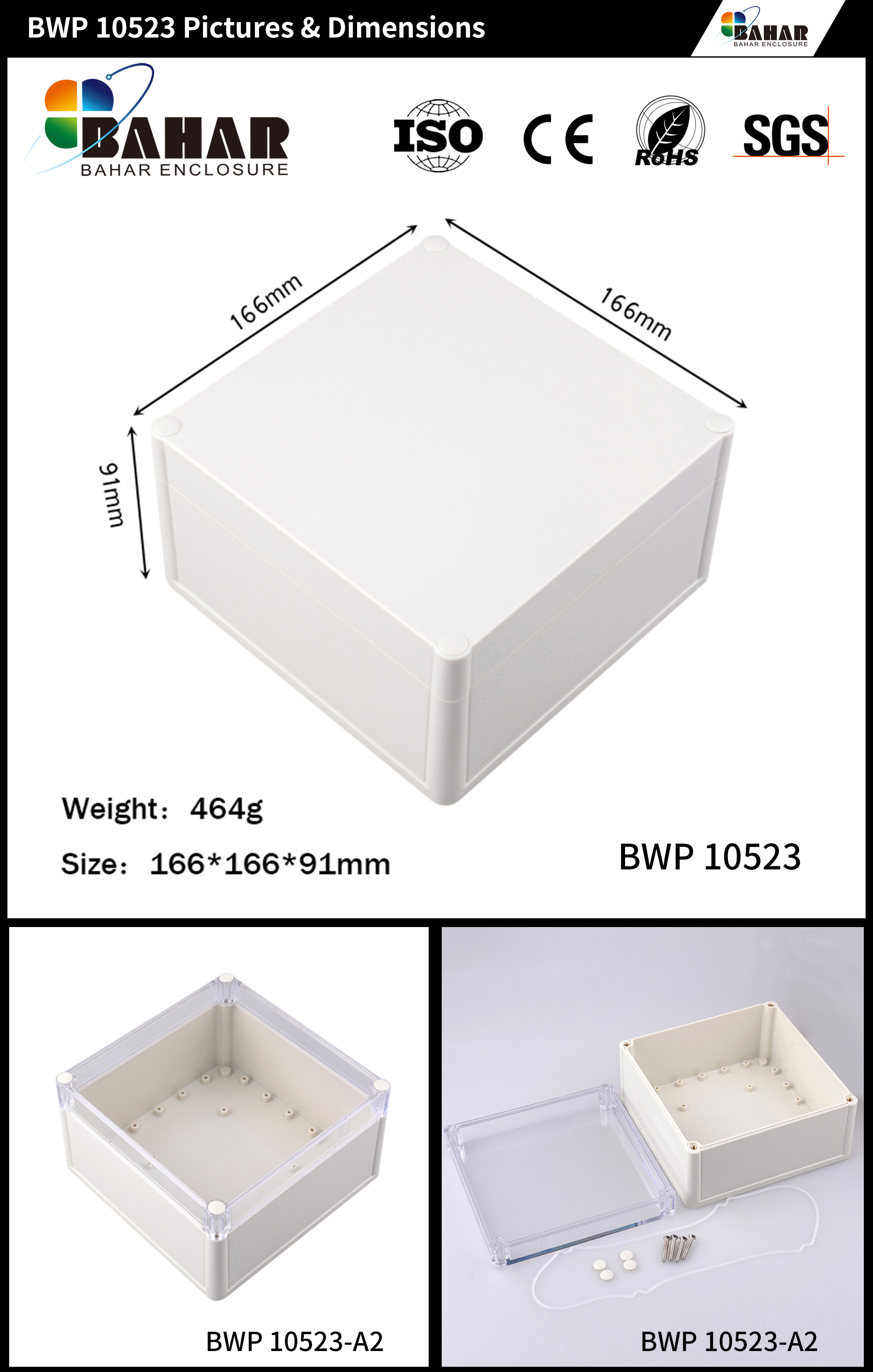
BWP 10523|166 × 166 × 91 mm
Vision Inspection Enclosure is an essential component in modern machine vision systems where cameras, AI processors and industrial controllers operate continuously under demanding environmental conditions. The BWP 10523 Vision Inspection Enclosure provides dependable IP68 protection for optical inspection equipment, automated quality control systems and intelligent manufacturing applications while offering sufficient internal space for professional electronic integration.
Machine vision has transformed modern manufacturing by allowing production lines to inspect every product automatically instead of relying on manual quality control. High-resolution industrial cameras, embedded AI processors and intelligent lighting systems work together to identify dimensional errors, missing components, surface defects and assembly mistakes within milliseconds. Although camera technology receives most of the attention, enclosure design plays an equally important role in maintaining inspection accuracy. The BWP 10523 Vision Inspection Enclosure provides a reliable IP68 housing developed for industrial vision equipment operating continuously in demanding production environments.
Unlike ordinary electronic assemblies, machine vision systems contain sensitive optical components that require stable mechanical positioning. Even minor enclosure deformation caused by vibration, temperature variation or accidental impacts can alter camera alignment and reduce inspection precision. Selecting a rigid enclosure with sufficient internal mounting space allows engineers to securely install cameras, embedded computers, LED lighting controllers and communication hardware while maintaining long-term calibration stability.
Another engineering challenge involves cable organization. Vision systems typically require GigE Vision, USB3 Vision, PoE Ethernet, trigger inputs, encoder signals and power connections within a compact installation area. Poor cable routing increases electromagnetic interference while making future servicing unnecessarily difficult. The internal geometry of the BWP 10523 Vision Inspection Enclosure supports organized wiring layouts that simplify installation and reduce troubleshooting time during production maintenance.
Production facilities often expose inspection equipment to coolant mist, airborne dust, cleaning chemicals and continuous mechanical vibration. Maintaining a sealed enclosure prevents contaminants from reaching sensitive processors and camera electronics while extending equipment service life. The transparent polycarbonate cover also enables technicians to verify operating indicators without opening the enclosure during routine inspections.
For equipment manufacturers, enclosure preparation is frequently one of the most time-consuming production stages. Bahar offers complete OEM enclosure customization, including CNC machining, camera openings, connector machining, laser engraving, silk-screen printing and UV printing according to customer CAD drawings. Receiving production-ready enclosures significantly shortens assembly time while improving manufacturing consistency.
Manufacturers building complete vision product families can also standardize their mechanical platform using additional models from the Plastic Waterproof Enclosure Series. Standardization simplifies mechanical design, inventory management and future product upgrades while maintaining a consistent appearance across multiple inspection solutions.
As Industry 4.0 continues driving automated manufacturing, machine vision equipment is becoming an essential component of intelligent factories. Combining durable ABS construction, transparent PC cover, dependable IP68 protection and flexible OEM manufacturing, the BWP 10523 Vision Inspection Enclosure provides an ideal housing solution for AI-powered inspection systems, industrial imaging devices and automated quality control equipment.
Vision Inspection Enclosure technology has become one of the key building blocks of AI-powered manufacturing. As production lines become smarter, manufacturers are replacing manual inspection with intelligent vision systems capable of detecting microscopic defects, verifying assembly accuracy and monitoring production quality around the clock. The BWP 10523 Vision Inspection Enclosure protects these sophisticated electronic systems inside a robust IP68 housing designed for continuous industrial operation while providing engineers with a flexible platform for OEM integration.
When people think about machine vision, they usually imagine only the industrial camera. In reality, the camera represents only one component of a much larger electronic ecosystem. A complete inspection station typically includes an embedded AI computer, industrial SSD storage, PoE switch, programmable lighting controller, digital I/O interface, power conditioning module and multiple communication interfaces. Housing these components inside a properly engineered Vision Inspection Enclosure simplifies installation while protecting expensive electronics from harsh factory conditions.
Many manufacturers now deploy edge AI directly beside the production line instead of sending every image to a cloud server. Local inference dramatically reduces latency, allowing robotic systems to reject defective products within milliseconds. This architecture also minimizes network traffic because only inspection results—not every captured image—need to be transmitted to factory management software.
Unlike narrow communication boxes, AI vision controllers often require a balanced internal layout. Engineers typically separate high-speed processing boards from power electronics to reduce electromagnetic interference and improve thermal distribution. The nearly symmetrical geometry of the BWP 10523 Vision Inspection Enclosure provides excellent flexibility for arranging industrial PCs, DIN-rail power supplies, Ethernet switches and optical interface modules without creating congested wiring paths.
The enclosure also leaves sufficient space for future hardware expansion. As AI accelerators evolve, manufacturers can upgrade processors, storage devices or networking equipment without redesigning the complete mechanical structure, reducing engineering cost throughout multiple product generations.
A modern inspection cycle begins when a photoelectric sensor detects the arrival of a product. The industrial camera immediately captures multiple high-resolution images while synchronized LED lighting eliminates shadows and reflections. The embedded processor performs image preprocessing, feature extraction and neural-network inference before generating a pass or fail decision. If an abnormality is detected, the controller activates pneumatic reject mechanisms, robotic arms or conveyor diverters within fractions of a second. Every stage of this workflow depends on reliable electronics protected by a durable enclosure capable of operating continuously across thousands of production hours.
Mechanical preparation is often overlooked during system development. Camera connectors, Ethernet ports, industrial circular connectors, antenna interfaces and cable glands all require precise machining. Performing these operations manually after purchasing a standard enclosure introduces dimensional variation and increases assembly time. Bahar provides complete OEM enclosure customization services, including CNC machining, laser engraving, silk-screen printing, UV printing and precision connector openings according to customer CAD drawings, allowing equipment manufacturers to receive production-ready housings directly from the factory.
Most OEM manufacturers develop several inspection systems ranging from compact barcode readers to high-performance AI inspection stations. Instead of selecting unrelated housings for every project, engineers can standardize their mechanical platform using models from the Plastic Waterproof Enclosure Series. Standardization simplifies documentation, accelerates mechanical design, reduces inventory complexity and creates a consistent appearance across an entire equipment portfolio.
The next generation of machine vision will combine artificial intelligence, hyperspectral imaging, 3D laser scanning and collaborative robotics into fully autonomous inspection cells capable of learning from production data in real time. Organizations such as the Association for Advancing Automation (A3) continue promoting industrial vision standards and intelligent manufacturing technologies that accelerate factory automation worldwide. By combining IP68 environmental protection, engineering-grade ABS construction, a transparent polycarbonate cover and extensive OEM customization options, the BWP 10523 Vision Inspection Enclosure provides manufacturers with a reliable foundation for developing the next generation of intelligent inspection equipment.
Oversizing an enclosure slightly is rarely a problem, but selecting one that is too small can create long-term reliability issues. Many OEM manufacturers initially calculate only the dimensions of the main controller board and ignore cable bending radius, connector clearance, cooling space and future upgrades. After assembly, technicians discover that Ethernet connectors cannot be unplugged easily, power supplies are difficult to replace and airflow inside the enclosure becomes restricted.
A professional Vision Inspection Enclosure should provide enough usable space rather than simply matching the external dimensions of the electronics. Engineers should always reserve installation clearance for maintenance tools, wiring modifications and future hardware revisions. This approach significantly reduces service time during the operational life of the equipment.
Many automation projects are designed to solve an immediate production problem, yet the equipment often remains in service for five to ten years. During that period, cameras may be upgraded from 2 MP to 12 MP, AI processors become faster and communication hardware evolves from Gigabit Ethernet to higher-speed industrial networks. Replacing the complete enclosure every time new electronics are introduced increases engineering costs unnecessarily.
The BWP 10523 Vision Inspection Enclosure allows manufacturers to retain the mechanical platform while updating only the internal electronics. This modular philosophy shortens redesign cycles and helps OEM companies introduce new product generations much faster.
Mechanical design mistakes rarely appear during factory acceptance testing. Instead, they emerge months later when maintenance engineers begin servicing installed equipment. If cable glands are positioned too closely together, replacing a damaged cable may require removing the entire controller assembly. If mounting holes are poorly located, technicians may have to disconnect every internal module before accessing a single component.
Experienced enclosure designers therefore evaluate maintenance accessibility before production begins. Serviceability is not merely a convenience—it directly affects the total cost of ownership for every machine delivered to the customer.
Leading automation companies rarely use a different enclosure for every machine they manufacture. Instead, they develop a standardized enclosure platform that can be reused across multiple inspection systems. This strategy reduces mechanical engineering time, simplifies purchasing, decreases spare-part inventory and creates a consistent appearance across the company’s entire product portfolio.
Bahar supports this strategy through comprehensive OEM enclosure customization, allowing manufacturers to apply different machining patterns, connector layouts, company logos and labeling while keeping the same enclosure family throughout multiple products.
Companies that build reliable vision equipment usually share one common practice—they design the enclosure at the beginning of the project rather than at the end. By considering cable routing, maintenance access, connector placement, thermal management and future expansion from the first design review, they avoid expensive redesign work during production. The enclosure becomes an integral part of the machine architecture rather than simply a protective box surrounding the electronics.
Manufacturers looking for additional enclosure sizes can explore Bahar’s complete Plastic Waterproof Enclosure Series, which offers multiple dimensions suitable for machine vision controllers, industrial computers and intelligent automation equipment. Industry organizations including the Association for Advancing Automation (A3) continue promoting best practices in machine vision integration, emphasizing that mechanical design is just as important as software and imaging technology in achieving long-term inspection reliability.
One of the most common reasons for enclosure redesign is poor connector planning during the early development stage. Mechanical engineers often focus on PCB placement first and postpone decisions regarding Ethernet ports, USB interfaces, power connectors, antenna feed-throughs and industrial circular connectors until the prototype has already been assembled. Unfortunately, relocating connectors after production drawings are released usually requires new tooling, revised machining programs and additional validation testing.
A well-designed Vision Inspection Enclosure should be treated as a complete mechanical system rather than simply a protective shell. Every connector must remain accessible after installation, cables should follow natural routing paths and maintenance engineers should be able to disconnect or replace individual components without dismantling the complete inspection unit.
Industrial cameras frequently use GigE Vision, USB3 Vision or fiber-optic communication cables that require a minimum bending radius to maintain signal quality. When connectors are installed too close to enclosure walls or mounting brackets, excessive cable stress develops during installation. This mechanical stress may not create immediate failures, but repeated maintenance eventually damages connectors or communication cables, increasing service costs throughout the equipment lifecycle.
Leaving sufficient clearance inside the BWP 10523 Vision Inspection Enclosure allows communication cables to follow smooth routing paths while reducing strain on expensive industrial connectors. Good cable management is not simply about appearance—it directly contributes to long-term system reliability.
This question appears surprisingly often during industrial equipment development. Laboratory prototypes are usually assembled by experienced engineers who understand every internal connection. Production machines, however, are assembled repeatedly by manufacturing technicians working under time constraints. If the enclosure layout is overly complex, assembly quality becomes inconsistent from one unit to another.
Successful OEM manufacturers therefore simplify mechanical assembly wherever possible. Components are positioned logically, mounting points remain accessible and wiring follows repeatable paths that minimize the possibility of assembly errors. An intelligently designed enclosure helps manufacturing teams produce identical machines with consistent quality instead of relying solely on operator experience.
Many design reviews involve only mechanical, electrical and software engineers. However, experienced service technicians often identify practical problems that are invisible during CAD modeling. They understand which connectors fail most frequently, which components require periodic replacement and which maintenance operations consume the most time in the field.
Including maintenance personnel during enclosure design frequently results in small mechanical improvements that significantly reduce future service costs. A relocated terminal block, an additional mounting clearance or improved connector accessibility may save hundreds of maintenance hours over the operational lifetime of large production lines.
Rather than purchasing standard enclosures and performing manual drilling in-house, many equipment manufacturers now request factory-prepared housings. Bahar provides complete OEM enclosure customization including precision CNC machining, camera openings, industrial connector machining, threaded holes, laser engraving, UV printing and silk-screen identification before shipment. This approach improves dimensional accuracy, shortens assembly time and eliminates many quality variations introduced by secondary machining.
Engineers developing multiple machine vision platforms can also standardize future products using the Plastic Waterproof Enclosure Series. Organizations such as the A3 Vision & Imaging community consistently highlight that successful machine vision systems are built through the integration of optics, software, electronics and mechanical engineering. A carefully planned enclosure is therefore not simply a housing—it becomes an active contributor to long-term inspection accuracy, manufacturing efficiency and equipment reliability.
Building a single prototype is relatively straightforward. Building ten thousand identical inspection systems is a completely different engineering challenge. Many machine builders discover that an enclosure performing perfectly during prototype testing becomes difficult to manufacture consistently when production volumes increase. Small mechanical details that seem insignificant during development—such as connector spacing, screw accessibility or PCB mounting locations—can dramatically influence assembly efficiency once production begins.
A well-designed Vision Inspection Enclosure should support repeatable manufacturing. Operators on the production line should be able to install electronic assemblies without modifying brackets, forcing cables into position or improvising mounting solutions. Every unnecessary assembly step increases manufacturing time while introducing opportunities for human error.
Many OEM companies invest heavily in optimizing circuit boards while overlooking the mechanical assembly process. In reality, significant production savings can often be achieved without changing the electronics at all. Relocating mounting bosses, increasing screwdriver clearance or repositioning cable entries may reduce assembly time by several minutes per unit. Across thousands of manufactured systems, these small improvements generate substantial cost reductions.
The internal structure of the BWP 10523 Vision Inspection Enclosure allows manufacturers to create organized installation zones for controllers, communication modules and power distribution hardware, helping technicians assemble equipment faster while maintaining consistent build quality.
One common mistake during equipment development is allowing mechanical documentation to fall behind actual production changes. Engineers update CAD files, technicians modify drilling positions and production staff introduce practical improvements that never appear in the official documentation. Months later, replacement parts no longer match field installations, creating unnecessary maintenance challenges.
Using standardized enclosure platforms significantly simplifies document control. Mechanical drawings, wiring layouts, spare-part lists and installation manuals remain synchronized because the enclosure architecture changes far less frequently than the internal electronics.
The first machine delivered to a customer is rarely the final version of a product. Successful manufacturers continuously improve their inspection systems based on customer feedback, field experience and technological advances. Choosing an enclosure that supports future expansion allows engineering teams to introduce new communication interfaces, upgraded processors or additional sensors without redesigning the complete mechanical structure.
This scalable design philosophy shortens future development cycles while protecting previous engineering investment. Instead of designing a new housing for every product revision, manufacturers evolve the internal electronics while preserving the established enclosure platform.
Preparing enclosure modifications during manufacturing is considerably more efficient than performing secondary machining after delivery. Bahar provides professional OEM enclosure customization including precision CNC machining, industrial connector cut-outs, camera openings, threaded inserts, laser engraving, UV printing and permanent product identification. Receiving fully prepared enclosures reduces workshop operations, improves machining accuracy and shortens overall production lead time.
Companies expanding their machine vision portfolio often introduce compact inspection units, multi-camera systems and AI-powered quality control stations over several years. By selecting compatible products from the Plastic Waterproof Enclosure Series, engineers create a consistent mechanical ecosystem across every product generation. This approach simplifies technician training, spare-part logistics, production planning and after-sales service while presenting a professional and unified appearance to customers.
Industrial organizations such as the Association for Advancing Automation (A3) continue emphasizing that successful automation products are not defined solely by software performance or AI algorithms. Long-term commercial success depends equally on practical mechanical engineering, manufacturability and serviceability. A thoughtfully engineered Vision Inspection Enclosure therefore becomes a strategic component that supports reliable production, efficient maintenance and sustainable product evolution throughout the lifecycle of modern inspection equipment.
One question frequently discussed during OEM product development is whether every machine should have its own dedicated enclosure or whether multiple products can share the same mechanical platform. Although creating a unique housing for each machine may appear to offer greater flexibility, it usually increases engineering complexity, purchasing costs and spare-part inventory. A carefully designed Vision Inspection Enclosure allows manufacturers to build several generations of inspection equipment using a single mechanical foundation while varying only the internal electronics.
For example, an entry-level vision system may contain a single industrial camera and compact controller, while a premium version adds AI acceleration, larger storage capacity and multiple Ethernet interfaces. If both products share the same enclosure architecture, engineering teams only need to redesign the mounting plate rather than developing an entirely new housing. This strategy significantly shortens development cycles while maintaining manufacturing consistency.
Customers rarely purchase identical inspection systems. Food manufacturers, pharmaceutical companies, electronics producers and automotive suppliers all require different camera resolutions, lighting configurations and communication interfaces. Instead of maintaining separate enclosure inventories for every customer, OEM manufacturers often create modular inspection platforms where the enclosure remains unchanged while internal hardware is customized for each application.
The BWP 10523 Vision Inspection Enclosure provides sufficient installation volume to support this modular approach. Additional communication cards, industrial PCs, lighting controllers or interface boards can be integrated without fundamentally changing the external mechanical design.
Engineering teams naturally focus on achieving successful prototype demonstrations, yet commercial production introduces entirely different priorities. Once hundreds of systems are assembled every month, production speed, inspection consistency and service accessibility become equally important. An enclosure that is easy to assemble repeatedly often delivers greater long-term value than one designed only for a single prototype.
This is why experienced manufacturers evaluate enclosure performance using production metrics rather than laboratory measurements alone. Assembly time, maintenance accessibility, machining repeatability and spare-part compatibility all become measurable engineering objectives during product development.
Many redesign projects begin because interface dimensions were never standardized. Camera brackets change, connector positions move and mounting holes require revision with every new product generation. Establishing fixed mechanical reference points inside the Vision Inspection Enclosure allows internal hardware to evolve while preserving the overall enclosure architecture. This engineering discipline reduces documentation changes and simplifies certification activities for future products.
To support this approach, Bahar offers professional OEM machining and enclosure customization, enabling manufacturers to specify precise connector locations, threaded openings, engraved identification, UV printing and CNC modifications before production begins. Factory preparation improves dimensional consistency while eliminating secondary machining during equipment assembly.
Successful automation companies rarely consider an enclosure to be a disposable component. Instead, it becomes part of their engineering platform—reused across multiple products, updated over many years and continuously refined as technology advances. By selecting compatible products from the Plastic Waterproof Enclosure Series, manufacturers can establish a standardized mechanical ecosystem that supports future innovation without repeatedly restarting enclosure development.
Industrial machine vision continues evolving through AI inference, high-speed imaging, 3D inspection and autonomous quality control. Resources published by the European Machine Vision Association (EMVA) consistently demonstrate that successful vision systems result from balancing optics, electronics, software and mechanical engineering. A well-planned Vision Inspection Enclosure is therefore not simply a protective housing—it becomes an integral engineering platform that supports scalable product development, manufacturing efficiency and long-term commercial success.
Most enclosure designs begin in a CAD workstation, but they spend almost their entire working life in the hands of installation and maintenance technicians. This difference creates an interesting engineering challenge. A Vision Inspection Enclosure that appears perfect in a 3D model may become frustrating to install once technicians begin routing cables, tightening connectors and replacing hardware inside a busy production plant. Successful enclosure design therefore requires understanding not only engineering principles but also the daily workflow of field personnel.
For example, maintenance engineers rarely have unlimited working space. Machine vision controllers are frequently mounted inside production cells, above conveyor systems or beside robotic stations where access is restricted. Every connector should remain reachable, every screw should be removable using standard tools and every internal component should be replaceable without dismantling the complete inspection system. These practical considerations often determine whether a machine can be serviced in ten minutes or remains out of production for several hours.
Mechanical designers naturally focus on structural rigidity, but production managers often evaluate a product differently. Every additional fastener increases assembly time, inventory complexity and inspection effort during manufacturing. Experienced OEM companies continuously search for opportunities to simplify enclosure assembly without sacrificing reliability.
Reducing unnecessary hardware not only accelerates production but also lowers the probability of assembly mistakes. A simplified internal architecture allows technicians to complete installation more consistently while improving long-term maintenance accessibility throughout the equipment lifecycle.
No manufacturing process is completely free from human error. Connectors may be inserted incorrectly, cables may be routed through the wrong opening and maintenance work may be performed under time pressure. Intelligent enclosure design anticipates these situations by naturally guiding technicians toward correct assembly procedures. Logical cable paths, clearly separated mounting zones and adequate installation clearance help reduce mistakes before they occur.
The BWP 10523 Vision Inspection Enclosure provides sufficient internal volume to organize controllers, communication hardware and power distribution equipment into dedicated functional areas instead of forcing all components into a crowded installation space.
Software engineers continuously introduce new AI algorithms, image-processing functions and communication features throughout the lifetime of a vision system. As processing requirements increase, hardware inevitably changes. If the enclosure has been designed with sufficient flexibility, upgrading electronics becomes a straightforward engineering task rather than a complete mechanical redesign.
This philosophy allows manufacturers to release several product generations while preserving the same external enclosure, reducing certification work and accelerating future product launches.
Rather than drilling, cutting and engraving every enclosure manually after delivery, many manufacturers now prefer receiving production-ready housings. Bahar offers complete OEM enclosure preparation services, including CNC machining, industrial connector openings, camera mounting cut-outs, threaded holes, laser engraving, UV printing and silk-screen identification directly from the factory. This approach improves dimensional repeatability while eliminating secondary machining operations during equipment assembly.
Manufacturers expanding their automation portfolio can also establish a standardized enclosure platform using the Plastic Waterproof Enclosure Series. Mechanical standardization reduces engineering effort, simplifies inventory management and allows new inspection products to reach the market much faster while maintaining a consistent industrial design language across the entire product family.
Industrial machine vision continues advancing through faster processors, AI acceleration and increasingly sophisticated optical technologies. Publications from the A3 Vision & Imaging community consistently demonstrate that successful inspection systems depend on the integration of optics, electronics, software and practical mechanical engineering. A carefully developed Vision Inspection Enclosure therefore becomes more than protective housing—it becomes an engineering tool that improves manufacturability, simplifies maintenance and supports product evolution for years to come.
One of the biggest challenges faced by OEM equipment manufacturers is predicting how their products will evolve over the next five to ten years. Cameras become faster, AI processors require additional interfaces and industrial communication standards continue changing. A well-designed Vision Inspection Enclosure should not be built only for today’s electronics—it should also accommodate tomorrow’s upgrades without requiring an entirely new mechanical design. This engineering philosophy reduces development costs while extending the commercial lifespan of the finished equipment.
During the initial design stage, engineers should reserve installation space for additional communication modules, higher-capacity power supplies and future expansion boards. Leaving approximately 20–30% unused internal volume inside the BWP 10523 Vision Inspection Enclosure often prevents expensive enclosure redesigns when next-generation hardware is introduced. The cost of slightly increasing available installation space is usually far lower than redesigning tooling and manufacturing processes several years later.
The internal layout of a Vision Inspection Enclosure directly influences how easily new hardware can be integrated. If power supplies, industrial PCs and communication modules are mounted too closely together, even a minor hardware upgrade may require rebuilding the entire internal structure. Separating functional areas—power distribution, image processing, networking and I/O control—creates a modular architecture that allows individual subsystems to evolve independently.
This modular design philosophy has become increasingly valuable as AI accelerators, high-speed industrial cameras and real-time image processing hardware continue advancing every year. Manufacturers can introduce improved electronics while preserving the same mechanical enclosure, reducing engineering risk and shortening development schedules.
Many inspection equipment manufacturers serve completely different industries using nearly identical hardware platforms. A single machine vision controller may inspect pharmaceutical packaging today, electronic assemblies tomorrow and automotive components next month. Instead of designing a different enclosure for every application, companies often standardize around one reliable Vision Inspection Enclosure that can be customized through connector layouts, machining patterns and branding while maintaining identical mechanical dimensions.
Bahar simplifies this manufacturing strategy through professional OEM enclosure customization services, allowing customers to specify connector locations, precision CNC machining, laser engraving, silk-screen printing and UV printing before production begins. Factory customization improves manufacturing efficiency while ensuring repeatable quality across every production batch.
Choosing compatible enclosure sizes throughout an equipment portfolio simplifies much more than purchasing. Mechanical drawings become reusable, installation procedures remain consistent and technicians become familiar with one enclosure architecture instead of dozens of unrelated designs. Manufacturers can further expand this strategy by selecting additional models from the Plastic Waterproof Enclosure Series, creating a complete family of mechanically compatible industrial housings.
According to engineering resources published by the European Machine Vision Association (EMVA), scalable hardware architecture is becoming increasingly important as machine vision systems integrate artificial intelligence, high-speed networking and advanced imaging technologies. By combining a flexible internal layout, durable ABS construction, transparent polycarbonate cover and dependable IP68 protection, the BWP 10523 Vision Inspection Enclosure provides manufacturers with a long-term mechanical platform capable of supporting multiple generations of intelligent inspection equipment.