Professional Enclosure Manufacturer | Custom Solutions
Home > Desktop Enclosure > BMD 60069-Square Electronics Enclosure


Ideal for compact controllers, sensor interfaces, electronic modules, instrumentation and custom OEM devices.
BMD 60069|98 × 98 × 28 mm


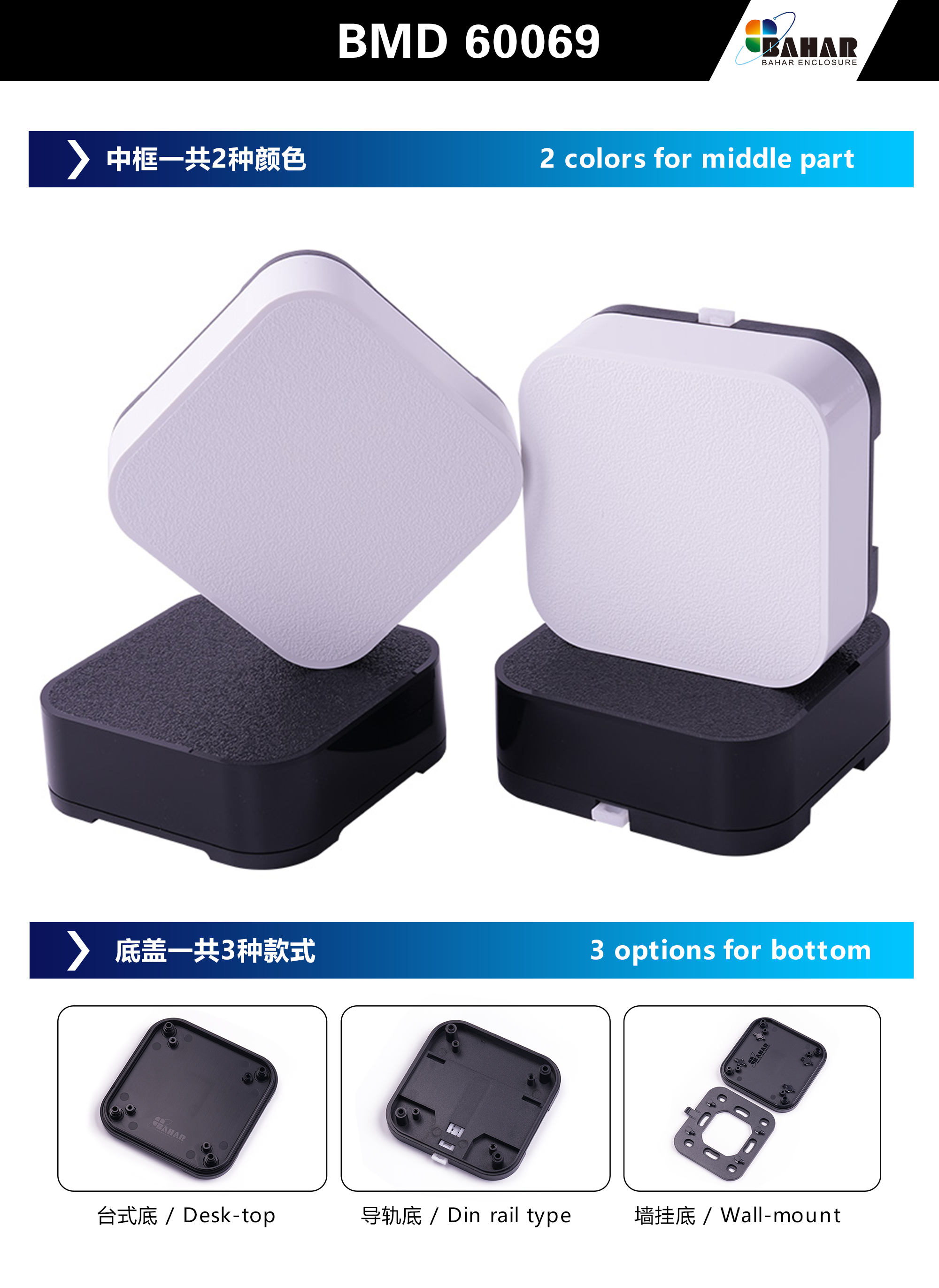
Compact ABS enclosure with 2 body colors and 3 base options.
|
🧱 Material
ABS Plastic
|
🎨 Colors
White / Black
|
|
🧩 Base Options
Desktop / DIN Rail / Wall-mount
|
🌡️ Temperature
-30°C to +85°C
|
| Application | Desktop Instrument Box, Junction Box, Control Box, Electronics Enclosure |
| Size | 98 × 98 × 28 mm |
| Weight | 94 g |
| Material | ABS |
| Body Color | White / Black |
| Base Options | Desktop base / DIN rail base / Wall-mount base |
| Temperature | -30°C to +85°C |
| Certificates | ABS, SGS, RoHS, CE |
Square Electronics Enclosure BMD 60069 is a compact ABS housing developed for electronic products that benefit from a balanced 98 × 98 mm footprint and a low 28 mm profile. Its nearly symmetrical internal geometry gives designers a practical platform for square PCBs, sensor boards, compact controllers, communication modules and custom electronic assemblies where efficient use of horizontal space is more important than enclosure depth.
Unlike conventional long rectangular project boxes, the BMD 60069 Square Electronics Enclosure provides similar usable dimensions in both directions. This geometry can simplify component positioning when a circuit board contains connectors, indicators or controls distributed around several sides of the PCB. The result is a compact enclosure platform that gives engineers greater freedom when planning the relationship between electronics and the final product housing.
The shape of an enclosure influences much more than its external appearance. It can affect PCB geometry, connector placement, internal cable routing and even the way users interact with the finished device.
With dimensions of 98 × 98 × 28 mm, the BMD 60069 Square Electronics Enclosure creates an almost equal X-Y design area. Engineers developing approximately square circuit boards can therefore use the enclosure footprint efficiently without leaving the unused longitudinal space commonly found inside elongated housings.
This characteristic makes the Square Electronics Enclosure especially interesting for electronics built around centrally positioned processors, sensor arrays, compact communication boards and interfaces requiring access from several sides.
Many modern electronic products no longer require tall internal housings. Surface-mount components, compact microcontrollers, integrated communication modules and low-profile power electronics allow sophisticated devices to be built on relatively thin PCB assemblies.
The 28 mm enclosure height makes BMD 60069 Square Electronics Enclosure particularly suitable for these applications. Instead of placing compact electronics inside an unnecessarily deep housing, designers can create a more proportionate finished product with a lower visual profile.
A lower enclosure profile can also be beneficial for desktop equipment where multiple devices share limited workspace. Laboratory benches, operator stations and electronics development areas often contain several instruments simultaneously, making efficient use of physical space increasingly important.
A distinctive advantage of BMD 60069 Square Electronics Enclosure is the availability of different base configurations. Depending on the selected model, the enclosure platform can support desktop, DIN rail or wall-mount installation.
This provides OEM designers with an opportunity to develop one electronic platform and adapt it to different installation environments without completely changing the external enclosure concept.
For desktop applications, the enclosure can provide a compact housing for controllers, small instruments, interface devices, testing electronics and monitoring equipment positioned directly within reach of the operator.
A compatible DIN rail base can transform the same general housing concept into an enclosure suitable for installation alongside electrical and automation equipment. This can be useful when an OEM develops both standalone and cabinet-mounted versions of the same electronic system.
The wall-mount configuration provides another option for electronics that need to remain fixed to equipment, machinery or another installation surface rather than occupying desktop space.
Developing several versions of an electronic product can become expensive when each version requires a completely different mechanical design. The multiple mounting possibilities of the BMD 60069 Square Electronics Enclosure can help engineers approach the project differently.
A manufacturer could potentially develop a common PCB architecture and use different enclosure configurations according to the final installation requirement. The desktop version may become a standalone controller, while another configuration could be incorporated into industrial equipment.
This type of platform strategy can simplify mechanical development, purchasing and product-family management while maintaining a recognizable enclosure architecture across different applications.
The BMD 60069 Square Electronics Enclosure is manufactured from ABS plastic, providing an electrically insulating housing material suitable for a wide range of indoor electronic applications.
ABS is also practical for projects requiring secondary machining. Connector apertures, indicator openings, push-button holes and other application-specific features can be incorporated according to the requirements of the electronic assembly.
Customers requiring other enclosure dimensions or structural designs can explore the Bahar Enclosure product range to compare alternative housings for electronic and industrial projects.
The enclosure is available in white and black, allowing designers to coordinate the housing with the visual identity of the finished electronic product.
A white enclosure can complement laboratory equipment, indoor monitoring devices, clean electronic interfaces and modern commercial electronics. Black can provide a more technical appearance for controllers, instrumentation and professional electronic equipment.
For OEM products that remain visible after installation, enclosure appearance becomes part of the product itself. The rounded corners and balanced square proportions of BMD 60069 Square Electronics Enclosure provide a more finished appearance than a purely functional rectangular utility box.
A standard enclosure becomes significantly more valuable when it can be prepared around the actual electronic design. Bahar provides custom enclosure manufacturing services for projects requiring machining and external identification.
Depending on the project drawing, customization can include CNC machining, drilling, connector openings, switch openings, display areas, laser marking, silk-screen printing and UV printing. This allows customers to begin with the standard BMD 60069 Square Electronics Enclosure structure and transform it into a housing prepared for their own electronic product.
The square geometry creates another useful design opportunity: engineers can consider all four sides of the enclosure during interface planning. Power input may be positioned on one side, communication connectors on another, while switches or additional interfaces can occupy the remaining surfaces.
This can reduce connector congestion and help create a cleaner PCB layout. It may also improve the user experience by separating connections according to function instead of concentrating every interface on a single panel.
Before machining, connector dimensions, PCB position, component height and required clearances should always be confirmed using the relevant mechanical drawings.
The BMD 60069 Square Electronics Enclosure can provide a practical mechanical platform for many compact indoor electronic products, including sensor interfaces, small control units, data acquisition electronics, communication modules, laboratory accessories, monitoring devices, signal interfaces and custom PCB-based equipment.
Its value is particularly strong when a project requires a compact square footprint together with flexibility in how the finished device will ultimately be installed.
An enclosure does not need to be large to provide design flexibility. The BMD 60069 Square Electronics Enclosure demonstrates how a compact housing can support different product concepts through its square geometry, low-profile structure, two body colors and multiple base configurations.
For engineers developing a new PCB-based product, this flexibility can make the enclosure useful from early prototyping through customized production. Instead of treating the housing as the final component selected after electronics development, the Square Electronics Enclosure can become part of the product architecture from the beginning.
For technical references related to electrical and electronic engineering, designers can also consult resources published by the IEEE.
Electronic enclosure design is often discussed from the perspective of protecting a circuit board, but products used directly by operators require another consideration: interaction. Buttons, status indicators, touch controls and communication ports must be positioned where users can reach and understand them naturally. The balanced geometry of the BMD 60069 Square Electronics Enclosure creates an interesting foundation for compact electronic products where the enclosure itself becomes part of the human-machine interface.
Because the housing measures 98 × 98 × 28 mm, designers can develop a relatively generous top interface without creating an excessively large device. This makes the Square Electronics Enclosure particularly useful for electronics where the upper surface may eventually contain indicators, membrane controls, identification graphics or other user-facing elements.
The broad upper surface can be treated as a dedicated interaction zone rather than simply an enclosure cover. A designer may reserve this area for LED indicators, printed operating symbols, compact displays or control buttons while keeping connectors around the enclosure sides.
Separating user controls from cable connections can make a finished electronic product easier to understand. Instead of mixing indicators and connectors across the same surface, the designer can create a clear visual hierarchy that guides the operator toward the functions used most frequently.
For OEM products, this approach also creates valuable space for model identification, company branding and application-specific instructions.
Compact connected devices are increasingly used throughout offices, commercial facilities and building automation systems. Environmental monitoring nodes, room controllers, occupancy interfaces and communication devices often require relatively little internal volume but benefit from a clean external appearance.
The BMD 60069 Square Electronics Enclosure can provide a practical enclosure platform for such indoor electronics, particularly when a project needs the possibility of desktop or fixed installation depending on the final application.
A manufacturer developing a family of smart-building products could use the enclosure concept for temperature monitoring, equipment interfaces, local controllers or communication nodes while adapting the internal PCB and external machining for each function.
Many IoT products combine a microcontroller, communication module, power circuitry and several external interfaces on a relatively compact PCB. The challenge is often not finding enough enclosure volume, but organizing these functions into a housing that remains visually appropriate for the final installation.
The Square Electronics Enclosure provides an alternative to oversized industrial boxes for indoor IoT applications. Its low profile can support compact electronics while the four surrounding sides provide potential locations for power, data, antenna or sensor connections according to the customer’s PCB architecture.
For wireless designs, engineers should evaluate antenna position, material interaction and required internal clearances during development rather than determining these parameters only after the PCB has been completed.
Square housings can be particularly effective for devices designed around a centrally positioned visual element. Instead of adapting a square display or indicator arrangement to a long rectangular enclosure, designers can create a more balanced relationship between the electronic interface and the surrounding housing.
Depending on the customer’s project and machining requirements, the upper surface of BMD 60069 Square Electronics Enclosure may be customized for suitable display or indicator openings. This creates possibilities for compact status monitors, digital indicators, environmental displays and specialized electronic instruments.
Two devices can use identical mechanical housings yet communicate completely different product identities through graphics. This provides an important advantage for manufacturers developing several electronic products around a shared hardware platform.
Different model numbers, operating symbols, connector labels, warning information and brand elements can be applied according to the intended product. Customers interested in preparing a production-ready housing can review Bahar’s enclosure customization capabilities for machining and branding options.
This approach can allow an OEM manufacturer to create several recognizable products while maintaining common enclosure dimensions behind the scenes.
For a new electronic project, enclosure suitability should ideally be confirmed before customization begins. Engineers can first evaluate the standard BMD 60069 Square Electronics Enclosure against the PCB dimensions, component heights, connector positions and intended mounting arrangement.
Once the mechanical relationship has been verified, customization drawings can define the required openings and external identification. This staged development process helps reduce the risk of producing customized housings before the electronic design has reached sufficient maturity.
A successful prototype proves that an electronic device can work. A successful production design must also prove that the same device can be assembled repeatedly and efficiently.
During enclosure planning, designers should consider how the PCB will be positioned during assembly, how cables will be connected, which components require access and whether technicians can perform these operations without unnecessary manipulation of the electronics.
The relatively simple geometry of the BMD 60069 Square Electronics Enclosure can support repeatable assembly planning, particularly when PCB orientation and external connector positions are established early in the development process.
OEM electronics manufacturers frequently sell one core device to multiple customers. Each customer may request a different logo, model designation, connector arrangement or installation method while the underlying electronics remain substantially unchanged.
BMD 60069 Square Electronics Enclosure provides a useful starting point for this type of product strategy. The same general Square Electronics Enclosure can support different external identities while allowing the manufacturer to retain a common mechanical platform.
This can be particularly valuable for private-label electronics, system integrators and manufacturers supplying customized versions of one controller to several industries.
Industrial and commercial systems increasingly process information close to the point where data is generated. Compact edge devices may collect sensor information, translate communication protocols or perform local control functions before transmitting selected information to a larger system.
These applications often require modest PCB space rather than a large electrical cabinet. A compact enclosure such as BMD 60069 Square Electronics Enclosure can therefore provide an efficient physical platform for suitable low-profile edge electronics intended for protected indoor environments.
When several units are distributed throughout a facility, compact dimensions can also help reduce the physical footprint of the overall system.
Connector labeling becomes increasingly important as compact devices gain additional interfaces. Power, communication, sensor and service connections should be identifiable without requiring technicians to consult documentation every time the equipment is accessed.
Customized printing around machined connector openings can help transform the enclosure into a self-explanatory part of the product. Labels such as POWER, INPUT, OUTPUT, LAN or application-specific identifiers can be positioned according to the final design.
This relatively small detail can improve installation quality and create a considerably more professional finished device.
Developing a completely new injection mold may be appropriate for very high-volume consumer products, but it is not always economically attractive for specialized industrial electronics. Engineering costs, tooling investment and development time can become significant before the first production unit is delivered.
Using an existing Square Electronics Enclosure and customizing it through machining and printing provides another development path. Manufacturers can achieve a project-specific appearance and connector configuration while avoiding the need to begin every project with dedicated enclosure tooling.
This strategy can be particularly attractive for specialized equipment, limited production quantities, new product launches and applications where electronics may continue evolving.
The BMD 60069 Square Electronics Enclosure can be incorporated into the engineering workflow before PCB layout is finalized. Mechanical dimensions can be considered alongside connector selection, component height and interface positioning so that enclosure and electronics evolve as one product rather than two independent parts.
Customers developing products that require different dimensions can also compare other housing formats through the Bahar Enclosure product portfolio.
By combining a 98 × 98 × 28 mm footprint, ABS construction, white or black body options and multiple base configurations, BMD 60069 offers more than a simple plastic container. It provides a configurable mechanical platform from which engineers can develop compact controllers, user interfaces, IoT electronics and customized OEM devices with a consistent professional identity.
Data collection is becoming an essential function in electronic equipment. From laboratory experiments and machine monitoring to environmental measurement and equipment diagnostics, compact data loggers allow information to be recorded locally before it is analyzed or transmitted elsewhere. These devices often combine a processor, memory, sensor interfaces and communication electronics within a relatively small PCB footprint. The BMD 60069 Square Electronics Enclosure provides a practical housing platform for suitable low-profile data acquisition electronics where compact dimensions and organized external interfaces are important.
Its 98 × 98 × 28 mm dimensions provide designers with a broad horizontal area for PCB development while keeping the finished device relatively thin. This proportion can be especially useful when several input channels need to be distributed around the sides of the housing instead of stacked vertically inside a deeper enclosure.
Many electronic systems depend on several sensors rather than one measurement point. A compact hub can collect signals from temperature, humidity, position, pressure or other application-specific sensors and transfer the information to a controller or monitoring platform.
The four-sided geometry of BMD 60069 gives designers multiple surfaces that may be considered when planning sensor connections. Instead of concentrating every cable on one side, compatible interfaces can potentially be distributed according to the PCB layout and installation requirements.
This approach can result in cleaner cable routing around the finished device and may simplify identification when several sensors are connected simultaneously.
Industrial and commercial equipment does not always communicate using the same interface. Existing machinery may need to exchange information with newer controllers, computers or monitoring platforms, creating demand for compact protocol conversion devices.
A customized Square Electronics Enclosure can provide a professional housing for suitable interface electronics that translate or bridge signals between different systems. One side of the enclosure can be dedicated to one connection group while another side accommodates the corresponding output interface.
This physical separation can make the purpose of each connection easier to understand while giving the finished converter a more organized appearance.
Rectangular enclosures often encourage designers to arrange electronics along a dominant horizontal axis. Square housings create a different design opportunity. Components can be organized around the center of the PCB, with supporting circuitry extending outward toward different interfaces.
This architecture may work well for products where a central microcontroller or processing section communicates with several surrounding functions. Power management can occupy one region, communication circuitry another, and sensor or user-interface electronics can be positioned according to the required external connection points.
For the BMD 60069, considering this relationship early can help engineers take advantage of its approximately equal length and width rather than simply treating it as another generic project box.
For products without large displays, the upper enclosure surface can still communicate significant information to the user. Printed diagrams, channel numbers, operating instructions, indicator descriptions or simplified connection guides can transform an otherwise plain cover into a functional information panel.
This can be especially valuable for specialized electronic products used by technicians. Clear labeling reduces uncertainty during installation and may decrease dependence on separate documentation for routine operations.
Bahar’s custom enclosure services can support project-specific machining and printing requirements based on customer drawings, allowing the external enclosure design to develop alongside the electronics.
Portable and desktop calibration electronics often require only a small PCB but need a professional housing that can accommodate input and output connections in an understandable arrangement. BMD 60069 can be considered for suitable compact calibration or reference electronics where the low-profile form factor complements bench-top use.
Connections can be positioned according to the required workflow, while the upper surface can carry operating information, calibration identification or customer branding. The resulting product can occupy little bench space while maintaining a clear visual identity.
Electronic training systems, development interfaces and engineering demonstration devices often need to expose several functions to the user without requiring a large instrument housing. A compact Square Electronics Enclosure can provide a useful mechanical platform for these products.
For example, an electronics manufacturer could develop a small interface unit containing communication electronics and status indicators while using external connectors to interact with test equipment. The square footprint provides sufficient surface area for clear labeling while remaining convenient for desktop use.
Not every machine interface requires a large HMI. Some applications only need to communicate basic conditions such as operating state, alarm status, communication activity or process availability.
A compact electronic status unit can perform this function using LEDs or other suitable indicators integrated into the enclosure design. The upper surface of BMD 60069 provides a relatively broad area compared with its overall dimensions, allowing designers to create clearly separated visual zones without requiring a large housing.
Such a device could be positioned on a workstation, fixed to suitable equipment or integrated into a broader monitoring system depending on the selected enclosure configuration and final engineering design.
Machine manufacturers frequently develop dedicated electronic tools for installation, configuration or maintenance of their equipment. These devices may never be sold as standalone commercial products, yet their mechanical quality still influences how easily technicians can work in the field.
BMD 60069 can provide a standardized housing for suitable diagnostic adapters, programming interfaces, configuration modules or electronic service tools. Custom connector openings and printed identification can make each tool immediately recognizable while protecting the internal PCB during normal handling.
For an OEM manufacturer, using a standardized enclosure for service electronics can also create a consistent visual relationship between the machine, its accessories and the tools used to maintain it.
Some electronic products contain interfaces intended for everyday users together with ports intended only for commissioning or maintenance. Placing all of these connections together can create confusion.
The multiple usable sides of a Square Electronics Enclosure provide designers with an opportunity to create physical separation between these interface categories. Frequently used customer connections can occupy one side, while configuration or service connections can be positioned elsewhere.
When combined with clear printing, this arrangement can improve usability and reduce the chance of connecting a cable to the wrong interface.
One product family may contain a basic model, an advanced version and a communication-enabled version. Although the internal electronics differ, maintaining identical external dimensions can simplify packaging, documentation, installation and customer familiarity.
BMD 60069 provides a possible foundation for this strategy. Manufacturers can evaluate different PCB arrangements inside the same 98 × 98 × 28 mm mechanical format while varying machining and external graphics according to each model.
For example, a basic version may require only power and sensor connections, while an advanced model adds communication ports and additional indicators. Both can retain a consistent product identity when developed around the same enclosure platform.
Manufacturers supplying electronics to distributors or other brands often need to create visually distinct products without changing the underlying hardware. Dedicated injection molds for every customer may not be practical, particularly for specialized industrial quantities.
A customizable standard enclosure provides another route. Customer-specific logos, model numbers, interface labels and graphics can differentiate the finished products while maintaining common mechanical components behind the scenes.
This strategy can reduce unnecessary mechanical variation and make it easier for OEM manufacturers to serve several customers using a shared electronics platform.
Compact product design affects more than the electronic device itself. Smaller and consistently shaped products can also simplify protective packaging, accessory organization and carton planning.
The regular square footprint of BMD 60069 can make packaging layouts relatively straightforward compared with irregularly shaped housings. For manufacturers shipping larger quantities internationally, efficient product dimensions can contribute to more organized packing and storage.
Packaging requirements should therefore be considered alongside PCB layout and enclosure customization when developing a commercial electronic product.
One of the strongest reasons to select an enclosure carefully is continuity. If the mechanical housing remains suitable through several electronics revisions, manufacturers can improve the internal product without repeatedly changing its external identity.
A processor may be upgraded, a communication module replaced or additional functionality introduced while the familiar BMD 60069 housing remains part of the product architecture. This can simplify manufacturing documentation and help customers recognize successive versions of the same device.
Engineers requiring alternative dimensions can compare additional solutions within the Bahar Enclosure product portfolio when developing broader electronic product families.
The enclosure is one of the few components that customers see every time they interact with an electronic device. PCB quality may determine how the product performs internally, but machining accuracy, interface organization, labeling and external proportions influence how professional that product appears externally.
For this reason, BMD 60069 should not be considered merely as a container for a circuit board. Its 98 × 98 × 28 mm dimensions, square geometry, ABS construction, white or black options and multiple installation possibilities allow engineers to approach it as part of the complete product-development process.
By coordinating PCB architecture, connector positions, installation method and external customization from the beginning, the BMD 60069 Square Electronics Enclosure can become the mechanical foundation for a distinctive OEM electronic device rather than simply the final box selected after development is complete.
Power management is becoming an increasingly important part of compact electronic design. Modern devices may need to regulate several voltage levels, monitor power consumption, protect sensitive circuits or distribute low-voltage power between multiple electronic modules. These functions can often be implemented on relatively small circuit boards, creating an opportunity to build complete power-management products without using oversized electrical housings.
The BMD 60069 Square Electronics Enclosure provides a 98 × 98 × 28 mm mechanical platform that can be considered for suitable low-profile power-management electronics. Its broad square footprint allows designers to distribute circuitry horizontally while reserving the surrounding enclosure sides for power inputs, outputs, communication interfaces or status indicators.
Compact electronics become easier to assemble and troubleshoot when their functional areas are clearly organized. Rather than placing every connector wherever space happens to remain, engineers can plan dedicated interface zones around the enclosure.
For example, one side of BMD 60069 may be assigned to power connections, another to signal interfaces and another to communication or service access. The fourth side can remain unused or accommodate additional application-specific connections.
This type of physical organization can make a finished electronic product more intuitive while also helping PCB designers establish a logical relationship between internal circuitry and external interfaces.
Many specialized electronic products perform relatively simple but valuable interface functions. USB converters, network adapters, communication bridges and custom data interfaces may contain sophisticated electronics while requiring only modest internal volume.
A low-profile Square Electronics Enclosure can provide these products with a more professional appearance than an oversized generic project housing. Appropriate connector openings can be positioned according to the customer’s PCB design, while printed labels can clearly identify each interface.
This combination is especially useful for OEM products intended for technical environments where users regularly connect and disconnect external equipment.
Square geometry can become particularly useful when an electronic product requires connections in several directions. Instead of positioning a long row of connectors along one edge, engineers may distribute compatible interfaces across different sides of the enclosure.
This approach can help avoid excessive PCB length and may produce cleaner cable arrangements around the installed device. It can also allow connectors serving different functions to be visually separated.
BMD 60069 therefore provides an interesting starting point for compact multi-port electronics such as signal distribution devices, communication interfaces, sensor hubs and specialized connection modules.
Energy monitoring is no longer limited to large industrial meters. Smaller electronic modules can collect electrical information from individual machines, subsystems or specialized equipment and transfer that information to a monitoring platform.
For appropriate low-voltage designs, BMD 60069 may provide a compact housing for supporting electronics associated with monitoring, data collection or communication functions. The selected enclosure configuration can then be matched to the installation environment.
A desktop version may be useful during testing or laboratory development, while another compatible base configuration may better suit integration into fixed equipment.
A display is not always necessary for communicating device status. Many electronic products can communicate effectively using carefully arranged LEDs or other compact visual indicators.
The broad upper surface of the BMD 60069 gives product designers room to develop meaningful indicator patterns. Instead of positioning LEDs randomly, indicators can be grouped according to function—for example, power status, communication activity, channel condition and alarm state.
Printed graphics around these indicators can further improve usability and give the finished product a distinctive visual character.
The top of a compact enclosure can effectively become a miniature dashboard. By combining indicators, labels and branding within a carefully planned graphic layout, manufacturers can create an interface that appears significantly more sophisticated than the underlying mechanical housing.
This is particularly valuable for OEM manufacturers because the enclosure can communicate product quality before the customer examines the electronics inside.
Bahar can evaluate customer drawings for suitable machining and printing requirements through its custom enclosure service.
Electronic accessories are often treated as secondary products and placed inside basic housings. However, accessories can strongly influence the customer’s perception of an equipment brand. Configuration adapters, communication modules, expansion interfaces and external controllers should therefore receive the same mechanical design attention as the primary equipment.
Using the BMD 60069 Square Electronics Enclosure across a family of accessories can establish a consistent visual language. Different accessories may use unique printing and connector configurations while sharing similar dimensions and external geometry.
This can make an entire equipment ecosystem appear more coordinated and professionally developed.
Industrial and commercial products frequently require optional functionality that not every customer needs. Instead of installing all possible electronics inside the primary equipment, manufacturers can move optional functions into external expansion modules.
A compact enclosure can provide the mechanical foundation for these modules. Depending on the electronics, an expansion device might add communication capability, additional sensor channels, data storage or another specialized function to the main system.
Because the expansion module remains physically independent, manufacturers can offer additional functionality without increasing the dimensions of every standard product.
This approach can also create commercial opportunities. Rather than selling one fully equipped product configuration, an OEM manufacturer can develop a core product and offer optional electronic modules according to customer requirements.
A standardized enclosure such as BMD 60069 can help these accessories maintain a consistent external appearance. Customers can identify them as members of the same product ecosystem even when each module performs a different electronic function.
This modular strategy can simplify product segmentation and allow manufacturers to serve both entry-level and advanced applications using related hardware platforms.
Production testing often requires custom electronics that never leave the manufacturer’s facility. Programming interfaces, PCB testers, signal simulators and verification modules may be used hundreds or thousands of times during manufacturing.
Although these devices are internal production tools, placing them inside a proper enclosure can improve handling and protect their circuit boards from accidental contact during repeated use.
The low-profile format of BMD 60069 can be useful for suitable bench-top testing electronics where technicians need frequent access to connectors and indicators without a bulky housing occupying valuable workspace.
Electronic products containing programmable controllers or microprocessors may require firmware installation during production. Manufacturers can develop dedicated programming interfaces that connect production computers or programmers to the device under test.
A customized Square Electronics Enclosure can house this interface electronics while providing clearly identified connections for the technician. Different connector groups can be positioned around separate enclosure sides to reduce mistakes during repetitive production operations.
When the same programming tool is used continuously, clear labeling and a practical physical layout can make small improvements in workflow that accumulate across large production quantities.
Manufacturing quality control often includes visual inspection of indicators before a finished product is packed. A thoughtful enclosure design can support this process by placing important status indicators where technicians can see them immediately.
If an electronic module performs an automatic startup test, for example, the enclosure graphics can clearly identify the indicators associated with power, communication and system readiness. Production personnel can then confirm device status without interpreting an unclear collection of LEDs.
Not every automation function requires a full industrial control cabinet. Specialized equipment may only require a compact electronic controller responsible for timing, sequencing, monitoring or simple logic operations.
For suitable applications, BMD 60069 provides enough surface area to develop a clearly identified compact control product while maintaining a shallow 28 mm overall profile.
The possibility of different base configurations also allows the mechanical concept to adapt as the same electronics move between development, standalone use and integration into a larger system.
Modern electronic products may require firmware updates throughout their commercial life. Mechanical design should therefore consider how technicians will access programming or service interfaces after the device has been assembled.
A dedicated service connection can be incorporated into the external design rather than requiring technicians to open the enclosure whenever an update is necessary. Alternatively, a project may intentionally keep certain interfaces internal when access needs to remain restricted.
The correct approach depends on the customer’s electronics, but considering service requirements before machining begins can prevent expensive design revisions later.
Physical enclosure space is limited, but digital information does not need to be. A QR code printed on the product can connect users to installation instructions, technical documentation, configuration information or another manufacturer-provided resource.
For compact products such as BMD 60069, this can be an efficient way to provide additional information without covering the enclosure with extensive text.
A carefully positioned QR code can also become part of the overall graphic design together with the company logo, model identification and interface labels.
Industrial design becomes especially powerful when customers recognize a manufacturer’s products before reading the brand name. Consistent enclosure proportions, graphics, labeling and interface organization can create this recognition across a product family.
BMD 60069 can serve as one mechanical building block within such a strategy. Manufacturers requiring different enclosure dimensions can explore other solutions through the Bahar Enclosure product portfolio while maintaining common branding principles across their equipment.
A new electronic product may change considerably during its first generations. Connector arrangements can evolve, PCB architecture may be revised and customer feedback can introduce functions that were not anticipated during initial development.
Beginning with a customizable standard enclosure can give manufacturers room to refine the product before considering dedicated injection tooling. Machined openings and printed graphics can be adjusted between production revisions without immediately committing to a completely new molded housing.
This makes the Square Electronics Enclosure particularly relevant for new OEM products, specialized industrial electronics and applications where production requirements may evolve over time.
A customer may never see the circuit board inside an electronic product, but they interact with the enclosure every time the device is installed, connected, inspected or serviced. Connector positions, readable labels, physical proportions and overall appearance therefore become part of the user experience.
The BMD 60069 offers engineers a compact mechanical canvas rather than prescribing a single application. Its 98 × 98 × 28 mm dimensions can support very different electronic concepts depending on the PCB, machining pattern, graphics and selected installation configuration.
When these elements are developed together, the enclosure can contribute directly to how professional, understandable and recognizable the final product feels to the customer.
Modern electronic equipment increasingly needs to identify not only what it does, but also where it belongs within a larger system. Asset identification, machine numbering, configuration references and service information can all become part of the physical product design. The BMD 60069 Square Electronics Enclosure provides a broad upper surface relative to its compact 98 × 98 × 28 mm dimensions, giving OEM designers useful space for structured product identification without requiring a larger housing.
Instead of treating labels as an afterthought, manufacturers can plan identification together with the enclosure graphics. Model information, serial references, connection diagrams, QR codes and operating symbols can occupy predefined areas, creating a cleaner and more consistent finished product.
Industrial machines often remain mechanically useful long after their original electronics become outdated. Rather than replacing an entire machine, manufacturers and system integrators may add compact electronic modules that introduce monitoring, communication or interface functionality.
These retrofit projects frequently have limited installation space. A large control enclosure may be unnecessary when the additional electronics consist of only a small PCB and several external connections.
The low-profile BMD 60069 can be considered for suitable retrofit electronics where a compact housing is preferred. Depending on the project, the electronic module could provide additional sensing, communication, status indication or another machine-specific function.
Retrofit electronics can also provide OEM manufacturers with a practical way to modernize earlier generations of their own products. Instead of changing the complete mechanical structure of installed equipment, an external module can introduce new electronic capabilities.
A customized Square Electronics Enclosure can become the recognizable housing for these upgrade modules. Existing customers may then add new functionality while continuing to use equipment they already own.
This creates an opportunity for manufacturers to extend the commercial life of existing product families while offering customers an alternative to complete equipment replacement.
Some electronic systems exist primarily to communicate a change in operating condition. A machine may need a local alarm interface, a remote notification module or a compact device that receives several status signals and presents them in an understandable format.
The square top surface of BMD 60069 provides useful space for arranging multiple indicators according to importance or function. A central alarm indicator can be visually separated from secondary status LEDs, while printed graphics help operators interpret conditions quickly.
This approach can create a simple but effective local status device without requiring a large display-based interface.
A square enclosure does not require a square user-interface layout. The balanced dimensions of BMD 60069 can also support circular or radial indicator arrangements centered on the upper surface.
For products showing multiple operating states, channels or process stages, a radial layout can create a distinctive visual identity while making efficient use of the available surface area. This provides industrial designers with an alternative to the conventional horizontal rows commonly found on rectangular electronic housings.
Custom graphics can then connect each indicator to its corresponding function, turning the enclosure cover into a recognizable part of the product design.
Some electronic products require only a small number of controls: perhaps a selector, several buttons and a few status indicators. In these situations, a large operator panel can add unnecessary size and cost.
BMD 60069 provides a compact format that can be evaluated for suitable low-profile control interfaces. The upper surface may accommodate application-specific controls while external connections can remain positioned around the enclosure sides according to the customer’s mechanical design.
This can be useful for dedicated equipment functions where a full HMI would provide significantly more capability than the application actually requires.
Laboratories increasingly automate repetitive tasks using small sensors, actuators, data interfaces and custom electronic controllers. These systems are often assembled from several independent modules positioned around test equipment.
Because bench space is valuable, compact housings can make laboratory automation systems easier to organize. The BMD 60069 Square Electronics Enclosure combines a relatively broad PCB footprint with a shallow profile, allowing suitable electronics to remain compact vertically.
White housing options may also complement clean laboratory equipment aesthetics, while black can provide a more conventional technical-instrument appearance.
Test equipment, imaging systems and automated instruments sometimes require dedicated electronics for triggering or synchronizing multiple devices. These modules may contain only modest circuitry but require several clearly identified connections.
The four available enclosure sides provide designers with flexibility when separating trigger inputs, outputs, power and service connections. Clear printing around each interface can help technicians configure the system correctly during installation and experimentation.
Specialized signal-processing products may also benefit from a shallow enclosure with multiple accessible sides. Suitable low-power electronics can be organized around a central PCB while external inputs and outputs are positioned according to signal flow.
For example, an engineer may place input connections on one side and output connections on the opposite side. This creates a physical relationship between the direction of the signal and the geometry of the product, potentially making installation more intuitive.
The same design principle can be applied to other electronics where users benefit from understanding the functional direction between interfaces.
Good industrial design can reduce the amount of written instruction a product requires. Connector placement, graphics and physical separation can communicate how a device should be used before the customer opens the manual.
A Square Electronics Enclosure provides four distinct side surfaces that can be assigned to different functional groups. Inputs can occupy one region, outputs another, power another and service connections the remaining area.
When PCB architecture and enclosure machining are planned together, this physical organization can become part of the product’s operating logic.
Manufacturers frequently need demonstration electronics for trade shows, distributor training and customer presentations. These devices may reproduce only selected functions of a larger machine while allowing customers to understand a technology without operating complete industrial equipment.
A compact enclosure can help transform demonstration electronics from an exposed development board into a professional presentation device. Branding, interface labels and carefully positioned indicators can create an appearance suitable for customer-facing environments.
BMD 60069 can therefore be considered not only for final production equipment but also for suitable supporting electronics used throughout the sales and demonstration process.
An exposed PCB may be acceptable inside an engineering department, but it can distract from the quality of the technology during a customer presentation. Moving the same electronics into a customized housing can dramatically change how the prototype is perceived.
Bahar’s enclosure customization service can support project-specific machining and printing based on customer requirements, helping manufacturers prepare housings around their actual electronics.
This can allow engineering prototypes, sales demonstrators and early production units to share a more consistent mechanical appearance.
Manufacturers of specialized electronic technologies sometimes provide evaluation kits so potential customers can test their hardware before integrating it into a larger system. The enclosure used for such a kit can influence the customer’s first experience with the product.
A customized BMD 60069 can provide a compact housing for suitable evaluation electronics while leaving enough external surface area for connector identification, operating instructions and company branding.
This creates a more complete evaluation experience than supplying an unprotected circuit board and may help customers understand how the technology could be incorporated into their own equipment.
Installers may need dedicated hardware to configure sensors, controllers or other field equipment during commissioning. Such tools can contain communication electronics and a small number of controls while connecting temporarily to the main equipment.
A compact Square Electronics Enclosure can provide a practical housing for these configuration devices. Because the tool may be handled frequently, clear connection identification and a straightforward interface become particularly valuable.
Manufacturers can also apply their own branding so that service accessories maintain the same professional identity as the primary equipment.
Some OEM manufacturers create a common mechanical product but install different PCBs according to customer requirements. One enclosure might therefore support several completely different electronic functions while maintaining identical external dimensions.
BMD 60069 can serve as a candidate platform for this strategy when the individual boards fit within its mechanical limitations. Different machining patterns or graphics can then identify each finished configuration.
This approach can reduce the number of mechanical components maintained in inventory while allowing the electronics portfolio to remain diverse.
The orientation of a circuit board during manufacturing can influence assembly speed. If technicians must repeatedly rotate the enclosure to access screws, connectors or wiring, even a small inefficiency can become significant across larger production quantities.
When developing BMD 60069-based electronics, engineers can consider assembly orientation from the beginning. Frequently accessed features can be positioned logically, and external interfaces can be arranged to support an efficient sequence of assembly and inspection operations.
Thinking about these details before finalizing PCB and machining drawings can help turn a functional prototype into a more production-friendly product.
One interesting characteristic of an almost square enclosure is that its geometry does not strongly dictate a single orientation. Product designers can decide which edge becomes the front according to the actual electronics rather than being forced by a long rectangular housing.
This freedom can be useful when different product variants require different interface priorities. One version may emphasize controls on one edge, while another may orient the same enclosure differently to accommodate its connectors.
The enclosure therefore provides a neutral starting geometry that can be given a specific visual direction through machining and graphic design.
Many electronic modules are not purchased independently. They are supplied as accessories or functional components within a larger machine, monitoring system or automation package.
In these situations, the enclosure should complement the broader equipment family without unnecessarily increasing installation size. BMD 60069’s compact proportions allow suitable electronics to maintain their own protected housing while remaining physically subordinate to the primary system.
Consistent logos, typography and labeling can then visually connect the module to the manufacturer’s larger equipment portfolio.
Selecting an enclosure early can influence PCB dimensions, connector orientation, packaging, installation methods, product graphics and even future product variants. For this reason, enclosure selection is often most effective when treated as part of product architecture rather than a purchasing decision made at the end of development.
The BMD 60069 provides a distinctive combination of a 98 × 98 × 28 mm format, ABS construction, white or black options and desktop, DIN rail or wall-mount base possibilities. These characteristics give designers several directions in which the same basic mechanical platform can evolve.
Customers developing broader equipment families can explore additional sizes and housing concepts through the Bahar Enclosure product range.
Compact electronics can contain considerable engineering value despite their physical size. The enclosure should communicate that value rather than making the product appear like an unfinished circuit placed inside a generic box.
Through thoughtful PCB positioning, connector organization, customized machining and professional graphics, the BMD 60069 Square Electronics Enclosure can become part of the identity of the finished electronic device.
For OEM manufacturers, that distinction matters. A well-developed housing can make a small controller, interface or electronic module easier to understand, easier to integrate and more convincing to the customer—turning compact electronics into a complete market-ready product.
Wireless connectivity allows electronic devices to exchange information without extensive signal cabling, creating new possibilities for compact controllers, monitoring nodes and intelligent accessories. Although wireless communication can reduce external wiring, the electronics still require a well-planned mechanical platform for the processor, communication module, power circuitry and user indicators. The BMD 60069 Square Electronics Enclosure offers a compact 98 × 98 × 28 mm format that can be evaluated for suitable indoor wireless electronic projects.
The relatively broad horizontal footprint gives PCB designers flexibility when positioning communication modules away from other electronic sections. Power circuitry, processing electronics and external interfaces can be organized into separate areas while maintaining the low-profile character of the finished product.
Wireless products require more than simply placing a radio module somewhere on the PCB. Antenna position, surrounding components and enclosure geometry should be considered together during development.
When BMD 60069 is selected early in the design process, engineers can evaluate antenna location while determining PCB orientation and external connector positions. This allows mechanical and RF considerations to develop together rather than attempting to solve antenna placement after the complete electronic assembly has already been designed.
Actual wireless performance depends on the selected radio technology, antenna design, PCB layout and surrounding installation environment, so final performance should always be validated using the customer’s complete electronic assembly.
Environmental monitoring systems increasingly use distributed electronic nodes rather than one centralized measurement device. Individual units may collect information from several sensors and forward the resulting data to another controller or software platform.
A customized Square Electronics Enclosure can provide a practical mechanical foundation for suitable indoor monitoring electronics. The internal PCB may combine sensing interfaces, processing electronics, local memory and communication hardware, while the external housing provides organized access to power or additional sensor connections.
The compact dimensions can be particularly valuable when several monitoring nodes need to be installed throughout the same facility without introducing visually dominant equipment.
Building automation increasingly distributes intelligence throughout individual rooms and functional zones. Instead of routing every signal directly to a large central controller, local electronic devices can process information closer to where it is generated.
BMD 60069 can be considered for appropriate compact electronics used as local interfaces, room-level controllers or communication nodes. Depending on the project design and selected base, the same general enclosure platform can support different installation concepts.
This flexibility gives equipment manufacturers an opportunity to develop related devices around a common housing while adapting their mounting method to each installation environment.
Many machines benefit from recording operating hours, production cycles or other usage information. A dedicated electronic counter can help maintenance teams understand how intensively equipment has been used and determine when scheduled service may be appropriate.
These devices do not necessarily require a large enclosure. A low-profile housing can contain the processing and interface electronics while the upper surface provides space for suitable indicators or identification graphics.
The BMD 60069 Square Electronics Enclosure therefore offers another possible direction for OEM manufacturers developing dedicated usage-monitoring accessories for their equipment.
When intermittent equipment problems are difficult to reproduce, recording operating events can provide valuable diagnostic information. A small electronic module may monitor selected signals and store relevant events for later analysis.
For suitable low-voltage electronics, BMD 60069 can provide a compact housing for the processing, memory and communication components required by such a device. External interfaces can be positioned according to the signals being monitored, while printed identification can help technicians install the recorder correctly.
This type of accessory can add diagnostic capability to existing equipment without requiring major changes to the primary control system.
The requirements of equipment commissioning are often different from normal operation. Installers may need temporary access to diagnostic information, configuration interfaces or test functions that end users rarely require.
Instead of permanently incorporating every commissioning function into the primary equipment, manufacturers can develop a dedicated electronic module used by installation and service teams.
A customized BMD 60069 can provide a professional housing for such electronics, with clearly identified connections and controls designed specifically around the commissioning workflow.
Experienced service technicians often develop their own adapters and diagnostic tools to simplify field work. OEM manufacturers can transform this knowledge into standardized service equipment that can be supplied to distributors, technicians and authorized maintenance partners.
The enclosure becomes an important part of this transformation. An exposed PCB and temporary cables may work during development, but a properly machined and labeled Square Electronics Enclosure turns the same electronics into a repeatable service product.
This can improve consistency across service teams and help reduce connection errors during equipment maintenance.
Specialized equipment may require electronics that coordinate several external signals before another system can operate. Depending on the application, a compact interface module can collect these signals and communicate the resulting condition to the primary controller.
The square geometry of BMD 60069 Square Electronics Enclosure allows different interface groups to be physically separated around the enclosure sides. This can help designers create an understandable relationship between incoming signals, outgoing connections and power interfaces.
Final electrical functionality and safety requirements must, of course, be determined by the customer’s engineering design and applicable standards.
Industrial facilities frequently contain machines from different generations. Older equipment may continue operating reliably but lack the interfaces required by newer monitoring or automation systems.
A dedicated electronic bridge can provide an alternative to replacing otherwise functional machinery. The module can be designed around the existing equipment interface on one side and the newer system connection on another, creating a clear physical transition between technologies.
The BMD 60069 Square Electronics Enclosure can provide a compact mechanical platform for suitable interface electronics where limited installation space and clear connector organization are important.
This concept can also help equipment manufacturers support their own installed product base. Instead of requiring customers to replace earlier machines when new connectivity features become available, an OEM may develop an upgrade accessory that adds selected functionality.
Such accessories can create additional value after the original equipment sale while helping customers extend the useful life of existing machinery.
By applying consistent graphics and branding to the enclosure, manufacturers can ensure that the upgrade module appears to be an intentional part of the equipment family rather than an unrelated aftermarket addition.
Some applications require users to select between multiple sensors, signals or operating channels. These functions can often be implemented using relatively simple electronics but still benefit from a clear physical interface.
The upper area of BMD 60069 Square Electronics Enclosure can provide room for suitable buttons, indicators or printed channel identification, depending on the customer’s mechanical requirements. Connections can then be organized around the enclosure sides according to the electronic architecture.
This combination can produce a compact device that remains easy to understand despite having several functional channels.
Product presentation has become increasingly important for industrial manufacturers selling through websites, distributors and digital catalogs. A finished electronic device should communicate its function clearly even before the customer reads the technical specifications.
The balanced proportions of the BMD 60069 Square Electronics Enclosure can provide a useful foundation for product photography because the enclosure offers both a broad upper branding surface and clearly visible side interfaces. Thoughtful printing can help logos, model identification and important controls remain recognizable in product images.
For OEM manufacturers selling online, this can contribute to a more consistent visual presentation across catalogs, technical pages and sales materials.
Clear product graphics are useful not only after purchase. They can also help prospective customers understand differences between product variants during the buying process.
If several devices share the same enclosure, each version can use distinctive model identification and interface labeling to communicate its purpose. Customers comparing products can therefore recognize functional differences without relying exclusively on internal PCB specifications.
This can be especially valuable for manufacturers offering several closely related controllers or electronic modules.
As electronic products move into serial production, traceability becomes increasingly important. Manufacturers may need to associate individual devices with production batches, test records or configuration information.
A defined area on the enclosure can be reserved for serial numbers, production codes, QR identification or other project-specific traceability information. Planning this area during graphic development creates a cleaner result than adding identification labels wherever space remains after production begins.
Bahar’s customization services can support project-specific enclosure machining and printing according to supplied drawings and production requirements.
Customers often recognize a product family through its shape before reading the model number. Maintaining common enclosure geometry across different electronic functions can therefore strengthen visual consistency.
A manufacturer might use BMD 60069 Square Electronics Enclosure for a communication interface, monitoring device and configuration tool, with each product receiving different machining and graphics. Although their internal electronics are different, the common square form helps visually connect them as members of the same equipment ecosystem.
This can be particularly effective for specialized OEM brands that want a recognizable product identity without investing in unique molded tooling for every electronic accessory.
Some manufacturers build a common electronic assembly and configure its final function near the end of production. Different firmware, connector options or external graphics may determine which model the unit becomes.
A standardized Square Electronics Enclosure can support this manufacturing strategy by keeping the core mechanical platform consistent. Product-specific differences can then be introduced through selected machining, printed identification and the electronics installed inside.
This approach may simplify inventory planning when several product variants share substantial common hardware.
The value of BMD 60069 Square Electronics Enclosure is not simply that it is small. Its almost equal length and width create a different internal design environment compared with narrow rectangular enclosures.
Engineers can consider quadrant-based PCB organization, central processing architectures or interfaces distributed around multiple edges. The enclosure geometry therefore becomes an input to the electronics design rather than simply a boundary around it.
When these possibilities are considered before PCB layout is finalized, designers may discover more efficient ways to arrange components and external connections.
Before committing to machining or printing, customers should verify the complete mechanical relationship between their electronics and the enclosure. PCB dimensions, component heights, connector bodies, cable clearances and mounting requirements should all be reviewed against the relevant product drawing.
When a project requires a different size or mechanical structure, designers can compare alternatives throughout the Bahar Enclosure product range before selecting the final housing.
The difference between an electronic module and a finished product is often found in the details surrounding the PCB. Organized connectors, readable labels, consistent branding and an enclosure proportioned to the electronics can significantly change how customers perceive the device.
BMD 60069 Square Electronics Enclosure provides OEM engineers with a compact mechanical starting point that can be developed around those details. Rather than hiding electronics inside an unnecessarily large generic box, manufacturers can create a housing strategy that reflects the actual scale and purpose of their design.
With its 98 × 98 × 28 mm format, ABS construction, white and black options and multiple base possibilities, the BMD 60069 Square Electronics Enclosure offers a flexible foundation for manufacturers seeking to transform compact PCB assemblies into organized, recognizable and customer-ready electronic products.
Modern electronic products increasingly need to preserve configuration information even when power is removed. Device addresses, operating parameters, calibration values and customer-specific settings may all be stored locally so equipment can return to its intended operating state after restart. The BMD 60069 Square Electronics Enclosure can provide a compact mechanical platform for suitable electronics that combine processing, local memory and external configuration interfaces within a low-profile device.
Its 98 × 98 × 28 mm format allows PCB designers to dedicate separate regions to processing, memory, communication and power functions without requiring an elongated housing. For OEM projects, this can be useful when developing configuration modules that need to remain compact while still presenting clearly identified connections to technicians.
Manufacturing equipment frequently operates with different parameter sets for different products or production processes. A compact electronic accessory can provide a physical interface for transferring, selecting or managing these configuration sets according to the architecture of the customer’s equipment.
Instead of adding additional controls to the primary machine, manufacturers can develop a dedicated accessory around the BMD 60069. The upper surface can carry model identification and operating information, while appropriate communication and power connections can be arranged around the enclosure sides.
This concept gives OEM manufacturers another way to extend the functionality of existing equipment without changing its main mechanical structure.
Development, commissioning and specialized equipment integration often require convenient access to signals that would otherwise terminate directly on a circuit board. A breakout interface can organize these connections into a more accessible external format.
The geometry of the Square Electronics Enclosure is particularly interesting for this type of product because different signal groups can potentially occupy different sides. Digital inputs may be located on one edge, outputs on another, while communication and power connections remain physically separated.
Clear external labeling can make the resulting interface easier to wire and troubleshoot, especially when technicians work with several channels simultaneously.
Customers often judge an electronic device during installation before they ever experience its full functionality. If connections are difficult to identify or cables interfere with one another, even technically advanced electronics can feel poorly designed.
Planning the BMD 60069 Square Electronics Enclosure around the installation workflow gives engineers an opportunity to improve this first interaction. Frequently accessed connectors can be placed where they are easiest to reach, while less frequently used service interfaces can occupy another surface.
The result can be an electronic product that feels intentionally engineered rather than simply packaged after the PCB design was completed.
Sensors and control systems do not always operate with directly compatible signals. Dedicated electronics may be required to condition, isolate, amplify or otherwise prepare signals before they reach another part of the system.
For suitable low-profile circuitry, BMD 60069 Square Electronics Enclosure can provide a compact housing platform for these interface modules. The square PCB area allows input and output circuitry to be arranged according to signal flow, while corresponding external connections can be positioned on different enclosure sides.
This creates a logical physical architecture in which the enclosure layout can reflect the electronic function occurring inside the device.
Some applications require one incoming low-voltage connection or signal to be distributed to several external devices. Instead of using exposed terminals or an oversized housing, a dedicated electronic distribution module can provide a cleaner system architecture.
The four-sided structure of BMD 60069 Square Electronics Enclosure provides several potential interface surfaces for this type of design. An incoming connection can be physically separated from multiple outgoing connections, while the top remains available for channel identification or status indicators.
The exact electrical design, ratings and protection requirements remain the responsibility of the customer’s engineering team, but the enclosure provides a flexible mechanical starting point.
Electronic multiplexing allows several signals or channels to share common processing or communication resources. These systems can reduce wiring complexity and make more efficient use of downstream electronics.
A customized Square Electronics Enclosure can be considered for suitable multiplexer electronics where multiple channel connections need to remain clearly organized. Channel numbering can be printed directly beside the corresponding interfaces, helping installers understand the product without relying solely on separate documentation.
Robotic systems are surrounded by supporting electronics. Sensors, communication adapters, auxiliary interfaces and diagnostic modules may all operate alongside the main robot controller.
These accessories often require considerably less enclosure volume than the primary control system. BMD 60069 Square Electronics Enclosure can provide a compact mechanical platform for suitable supporting electronics where a shallow housing and organized interfaces are advantageous.
The ability to develop different mounting configurations from the enclosure platform can also help manufacturers adapt related accessories to different parts of a robotic workstation.
Before an electronic or electromechanical product leaves the production line, manufacturers may perform a final functional test. Dedicated test electronics can automate parts of this process by generating signals, checking responses or communicating with the device under test.
A production test module may be used thousands of times, making mechanical organization important even though customers never see the equipment. Placing the electronics inside a customized BMD 60069 Square Electronics Enclosure can protect the PCB while giving production technicians clearly identified test connections.
This can help transform temporary engineering hardware into a repeatable manufacturing tool.
Production environments reward simplicity. When operators repeat the same connection sequence throughout a shift, connector location and labeling can influence both speed and accuracy.
The BMD 60069 Square Electronics Enclosure can be customized so that connections follow the physical sequence of the testing procedure. Numbered ports, directional graphics and dedicated status indicators can help operators recognize each step more quickly.
This illustrates how enclosure customization can contribute to manufacturing efficiency even when the housing itself contains relatively simple electronics.
Sales engineers and distributors often need portable demonstration equipment that allows customers to experience a technology without installing a complete industrial system. A compact electronic module can reproduce key inputs, outputs or communication functions in a form that is easier to transport and demonstrate.
The BMD 60069 Square Electronics Enclosure can help turn suitable demonstration electronics into a professional presentation tool. Company branding, interface names and simplified operating instructions can be incorporated into the enclosure design so the demonstrator communicates clearly during customer meetings.
Industrial purchasing decisions frequently involve both engineers and commercial teams. A product that is difficult to understand may require lengthy explanation even when its technical performance is excellent.
Thoughtful enclosure graphics can reduce this barrier. Inputs, outputs and operating states can be visually organized so prospective customers understand the basic purpose of the device quickly.
For OEM manufacturers, this means enclosure design can contribute not only to engineering quality but also to the sales presentation of the finished product.
Manufacturers working with international distributors may supply the same core electronics under several commercial identities. Each distributor may require its own logo, product designation or language-specific interface information.
Using a common BMD 60069 Square Electronics Enclosure can allow the mechanical platform to remain standardized while external graphics are adapted according to the commercial requirement. This approach can simplify production compared with maintaining a completely different enclosure design for every sales channel.
Customers can discuss suitable machining and graphic requirements through Bahar’s custom enclosure service.
Products sold internationally may also require different external information depending on the destination market. Model references, connection terminology and operating labels may vary while the underlying electronics and enclosure dimensions remain unchanged.
A standardized Square Electronics Enclosure provides a practical basis for this type of product localization. Manufacturers can preserve common mechanical architecture while preparing appropriate external identification for each intended market.
This can reduce unnecessary engineering variation and make global product-family management easier.
Some electronic systems require a controlled method for restoring firmware or recovering configuration after a service event. Rather than exposing development hardware directly, an OEM manufacturer may create a dedicated interface tool for trained technicians.
BMD 60069 Square Electronics Enclosure can provide a compact housing for suitable service electronics, with clearly differentiated equipment-side and technician-side connections. The enclosure can also carry instructions or warnings relevant to the service procedure.
Providing a standardized recovery tool can help manufacturers make advanced maintenance procedures more repeatable across different service locations.
Equipment downtime can be reduced when supporting electronic modules are designed for straightforward replacement. Instead of repairing a PCB at the installation site, technicians can exchange the complete accessory and return the original unit for inspection.
A recognizable enclosure format helps this process because technicians can quickly identify the correct module and its connections. Model numbers and interface labels can be integrated directly into the external design.
For equipment manufacturers, field-replaceable accessories can also simplify after-sales spare-parts management.
Not every monitoring device remains permanently installed. Engineers may temporarily deploy electronics to collect information during commissioning, troubleshooting or process optimization and remove the device after sufficient data has been gathered.
A compact housing is advantageous in these situations because temporary equipment should be easy to position without significantly disturbing the existing installation.
BMD 60069 Square Electronics Enclosure can be considered for suitable portable or temporarily installed indoor monitoring electronics, subject to the requirements of the customer’s complete design.
A machine manufacturer may eventually develop numerous supporting products: configuration tools, communication adapters, monitoring modules, test devices and expansion accessories. If every item uses an unrelated enclosure, the product ecosystem can appear fragmented.
Using common mechanical characteristics can create a stronger visual relationship between these products. The square geometry of BMD 60069 Square Electronics Enclosure can become one recognizable element, while consistent logo placement, typography and indicator styles reinforce the connection between different devices.
Customization is sometimes viewed primarily as adding a logo, but its engineering value can be much greater. Precisely positioned openings can improve connector accessibility. Printed symbols can reduce wiring errors. Numbered channels can simplify troubleshooting. A carefully planned top interface can help users understand equipment status faster.
For this reason, machining and printing should ideally be developed from the same engineering drawing rather than treated as unrelated production operations.
When the PCB, enclosure and graphics are considered together, the standard BMD 60069 can become a purpose-built housing for the customer’s electronics.
A new electronic product rarely remains unchanged forever. Customer feedback may lead to additional indicators, another communication interface or revised internal electronics in the next generation.
Leaving some mechanical flexibility during the original design can make these changes easier. Engineers can consider whether unused enclosure surfaces or PCB areas could support future functionality instead of designing the first generation with absolutely no expansion possibility.
The balanced footprint of the Square Electronics Enclosure gives designers several directions for future interface development without automatically increasing the external dimensions.
The commercial value of an enclosure is not determined only by its material or dimensions. Value increases when the housing reduces engineering work, supports several product variants, simplifies assembly and helps the finished electronics communicate quality to the customer.
BMD 60069 Square Electronics Enclosure provides a standard ABS platform, but its potential extends into product development, manufacturing, service and branding. The same basic enclosure can play very different roles depending on the PCB installed inside and the customization applied outside.
Manufacturers requiring additional dimensions can compare other enclosure solutions through the Bahar Enclosure product portfolio.
The 98 × 98 × 28 mm dimensions of BMD 60069 Square Electronics Enclosure define its physical boundaries, but they do not define a single application. Within this compact format, engineers can develop interfaces, monitoring modules, service tools, signal electronics, test equipment and many other specialized PCB-based products.
Its square form offers a useful alternative to conventional elongated project housings, particularly when electronics benefit from a balanced PCB area or connections distributed across several sides.
By combining thoughtful PCB architecture, application-specific machining, clear labeling and professional branding, the BMD 60069 Square Electronics Enclosure can help OEM manufacturers convert compact electronic assemblies into products that are easier to manufacture, easier to use and more convincing to customers.
Electronic products often require a configuration stage before they are ready for installation. Network addresses, device identities, communication parameters and customer-specific settings may need to be assigned during production or commissioning. Instead of performing these operations through exposed development boards, manufacturers can create dedicated provisioning electronics that make the process more controlled and repeatable.
The BMD 60069 Square Electronics Enclosure provides a compact mechanical platform for suitable provisioning interfaces. Its 98 × 98 × 28 mm dimensions allow processing and communication electronics to remain contained within a small desktop device while leaving multiple sides available for equipment, power and service connections.
When hundreds of electronic units must be configured during production, even small improvements in workflow can have a meaningful impact on assembly efficiency. A dedicated setup interface can reduce the number of loose adapters and temporary cables required at each workstation.
BMD 60069 Square Electronics Enclosure can be customized around the actual configuration process. A connection to the product under setup may occupy one side, while communication with the programming computer can be positioned separately. Status indicators on the upper surface can show whether configuration is waiting, active or complete.
This transforms a collection of engineering hardware into a repeatable production tool with a clear operating sequence.
Some equipment ecosystems require supporting electronics that identify compatible accessories, exchange device information or provide controlled communication between system components. These modules can be physically small while still playing an important role in the overall equipment architecture.
A customized Square Electronics Enclosure can give such electronics an independent and recognizable mechanical identity. Clear connection labeling can distinguish equipment-side and accessory-side interfaces, while the top surface remains available for product identification and operating status.
Distributed systems may contain several small electronic devices generating information independently. Instead of connecting every device directly to a central computer, a local data concentrator can collect information from nearby sources and organize it before forwarding selected data upstream.
The approximately equal width and length of BMD 60069 Square Electronics Enclosure can be useful for electronics requiring several peripheral connections around a central processing section. Different groups of inputs can occupy separate sides while communication with the primary system remains clearly differentiated.
This physical organization can make complex connection arrangements easier to understand without requiring a substantially larger enclosure.
The square geometry offers an opportunity to divide both the PCB and enclosure into four functional zones. Rather than developing the board as one continuous rectangular layout, engineers can assign different quadrants to specific electronic functions.
One quadrant may contain power-management circuitry, another processing electronics, another communication hardware and the final region application-specific interfaces. External connections can then be positioned close to the corresponding circuitry.
This approach is not required for every project, but it illustrates how the physical geometry of a Square Electronics Enclosure can actively influence PCB architecture.
Rental equipment operators often need supporting electronics for usage tracking, configuration or equipment identification. These accessories may be transferred between machines, serviced regularly or replaced independently of the primary equipment.
A compact standardized housing can make these modules easier to identify and manage. Model information, unit numbers or machine compatibility references can be incorporated into the enclosure graphics so technicians immediately understand where each device belongs.
For suitable indoor electronic applications, BMD 60069 Square Electronics Enclosure can provide a compact starting point for these specialized equipment-management modules.
Engineers testing controllers frequently need to reproduce sensor conditions without connecting the complete machine. A dedicated electronic simulator can generate representative signals so software and control logic can be evaluated at a workbench.
BMD 60069 Square Electronics Enclosure can be considered as a housing for suitable compact simulation electronics. Controls and indicators can occupy the upper surface, while simulated outputs and power connections can be arranged around the sides.
By placing development electronics inside a finished enclosure, engineering teams can create test tools that are easier to share between departments and more resistant to accidental handling damage than exposed PCBs.
Many valuable engineering tools begin as one-off prototypes created by an individual engineer. Over time, other departments may need the same functionality, but reproducing undocumented temporary hardware can become difficult.
Moving proven electronics into a standardized enclosure creates an opportunity to formalize the design. Connector positions, operating instructions and model identification can be documented, allowing identical tools to be manufactured for production, quality control or international service teams.
This is another area where enclosure design creates value beyond the electronics contained inside it.
Quality-control stations may need dedicated electronics to communicate with products, read sensors or verify particular functions before shipment. These interfaces should be straightforward because operators may test large numbers of units every day.
A customized BMD 60069 Square Electronics Enclosure can provide clearly separated connections and simple visual feedback. Instead of requiring technicians to interpret raw development-board indicators, the top surface can present only the information relevant to the inspection process.
Pass, activity and error indicators can be positioned according to the workflow established by the manufacturer, helping make the test procedure easier to repeat consistently.
Manufacturing teams sometimes compare production units against a known reference device or signal condition. Dedicated electronics can help automate this comparison and provide technicians with a simple result.
A compact Square Electronics Enclosure can house suitable comparison circuitry while providing separate connections for reference and test signals. Using different sides for these connections can reduce confusion and make the physical test arrangement easier to understand.
Kiosks and unattended equipment often contain several small electronic modules behind the visible user interface. Communication adapters, peripheral controllers and monitoring electronics may each perform specialized functions while remaining hidden inside the larger system.
Because internal installation space can be limited, these supporting devices benefit from compact dimensions. BMD 60069 Square Electronics Enclosure offers a shallow enclosure format that can be evaluated for suitable kiosk electronics requiring an independent ABS housing.
The availability of different base concepts can also provide flexibility when determining how the module should be positioned within the larger equipment assembly.
Instead of integrating every peripheral function onto one large main PCB, equipment designers may separate certain functions into independent electronic modules. This can simplify troubleshooting and allow individual subsystems to evolve without redesigning the primary controller.
A dedicated enclosure helps turn each subsystem into a clearly defined replaceable component. Connections can be identified according to function, and different modules can share a consistent external design even when their internal electronics differ significantly.
BMD 60069 Square Electronics Enclosure can therefore contribute to modular equipment architecture where compact supporting electronics need their own mechanical identity.
Before committing to larger production quantities, OEM customers may want to evaluate not only electronic performance but also the appearance and usability of the finished device. A properly customized enclosure makes this evaluation much more realistic.
Instead of presenting a PCB and describing what the final product will eventually look like, manufacturers can prepare an approval sample using the intended enclosure, machining pattern and graphics.
This gives customers an opportunity to evaluate connector accessibility, label positioning, branding and overall dimensions before production begins.
Drawings are essential for engineering, but physical interaction can reveal issues that are difficult to identify on a screen. A connector may technically fit yet be inconvenient to access, or printed information may appear smaller than expected once applied to the actual enclosure.
Evaluating a customized BMD 60069 Square Electronics Enclosure sample before batch production can help customers identify these details earlier in the project.
Bahar’s enclosure customization services can support machining and printing requirements based on customer drawings for OEM projects.
System integrators frequently need specialized interface electronics that connect equipment from different manufacturers. Production volumes may be moderate, yet the finished module still needs to appear professional when delivered as part of a complete project.
A standard Square Electronics Enclosure provides a practical alternative to developing dedicated injection tooling for every integration project. The housing can be customized around the required connectors and identification while the internal electronics remain specific to the application.
This can help integrators move from prototype to customer installation more efficiently.
A single automation project may require a unique interface that will only be produced in limited quantities. Designing a dedicated molded housing for such a project may introduce unnecessary tooling cost and development time.
Starting with BMD 60069 Square Electronics Enclosure and adding application-specific machining can provide another route when its dimensions suit the electronics. Connector openings and printed identification can make the standard enclosure highly specific to the project without changing the fundamental molded structure.
Cable management outside an enclosure is sometimes just as important as component arrangement inside it. When all connections emerge from one side of a small device, cables can become crowded and difficult to route.
The four-sided geometry of BMD 60069 Square Electronics Enclosure allows engineers to consider different cable directions during product development. Connections serving equipment located in different physical directions can potentially exit from the nearest side of the enclosure.
For fixed installations, this can help create a cleaner overall system layout and reduce unnecessary cable bending around the device.
The best connector arrangement depends on where the product will actually be installed. A desktop device may benefit from connections concentrated toward the rear, while equipment-mounted electronics may require cables to exit from several directions.
Because BMD 60069 Square Electronics Enclosure does not strongly dictate one orientation, designers can define the functional front, rear and sides according to the final application.
This flexibility should be considered before machining drawings are finalized so that enclosure customization supports the real installation rather than only the appearance of the standalone product.
Once an OEM manufacturer validates a mechanical format, it can become the foundation for several related devices. A monitoring unit, configuration interface, diagnostic tool and communication adapter could potentially share the same external footprint while using different electronics and customization.
This strategy can simplify packaging design, product photography, documentation and accessory organization. Customers also become familiar with the physical format, strengthening recognition across the manufacturer’s electronic product family.
Products with consistent dimensions can be easier to organize within cartons, demonstration cases and distributor inventory. Accessories may share protective packaging concepts even when their functions differ.
The regular 98 × 98 mm footprint of BMD 60069 Square Electronics Enclosure provides predictable external geometry that manufacturers can consider when developing packaging for a family of compact electronic devices.
Mechanical standardization can therefore create benefits that extend beyond engineering and into logistics and product presentation.
Product differentiation does not always require completely different electronics. Manufacturers may offer standard and premium versions distinguished by functionality, graphics or interface options.
A carefully customized enclosure can help communicate these differences. Distinct model markings, graphic layouts or interface labeling can establish separate product positions while retaining the same basic BMD 60069 Square Electronics Enclosure mechanical platform.
This allows OEM manufacturers to develop broader commercial product ranges without multiplying mechanical designs unnecessarily.
A circuit board that fits inside an enclosure is not automatically optimized for production. Engineers should also consider how the PCB will be inserted, how connectors align with machined openings, how technicians access mounting points and how the completed assembly will be inspected.
Coordinating these requirements early can reduce assembly difficulty and help maintain consistent quality as production volume increases.
The BMD 60069 Square Electronics Enclosure can therefore be used as a fixed mechanical reference during PCB development rather than waiting until the electronics are complete before selecting a housing.
Compact product design is not simply the process of making everything smaller. Effective miniaturization requires each part of the available space to serve a clear purpose.
The approximately symmetrical footprint of BMD 60069 Square Electronics Enclosure encourages engineers to think differently about PCB layout, connector distribution and top-surface interaction. Instead of leaving unused space at the ends of a long enclosure, designers can organize functionality around a more balanced internal area.
Customers requiring different mechanical proportions can compare additional options through the Bahar Enclosure product range.
BMD 60069 Square Electronics Enclosure begins with a straightforward combination: a compact square footprint, 28 mm height, ABS construction, white or black color options and several possible base configurations. The creativity comes from how an OEM manufacturer builds around those characteristics.
The same housing can support a production tool, electronic interface, configuration module, monitoring device or specialized customer product when the internal PCB and external customization are developed appropriately.
This flexibility allows the BMD 60069 Square Electronics Enclosure to serve not merely as the final protective component around a circuit board, but as a reusable mechanical platform that can help manufacturers develop new electronic products faster, organize product families more consistently and present compact technology to customers in a more professional form.
Before a new electronic product reaches mass production, engineers often need dedicated hardware to validate how the device behaves under different operating conditions. Development boards may be sufficient during early experiments, but later validation usually benefits from electronics packaged in a form that more closely represents the final product. The BMD 60069 Square Electronics Enclosure provides a compact mechanical platform that can help engineering teams move experimental electronics toward a more structured validation stage.
With its 98 × 98 × 28 mm dimensions, the enclosure can accommodate suitable low-profile PCB assemblies while providing external surfaces for test connectors, status indicators and identification. Engineers can therefore evaluate not only electronic performance but also practical aspects such as connector accessibility, cable direction and user interaction before finalizing the commercial design.
Electronic verification may involve repeatedly applying signals, changing operating modes or connecting measurement equipment. When these procedures are performed using exposed PCBs, connections can become difficult to organize and accidental handling may affect the test setup.
Housing the verification electronics inside BMD 60069 Square Electronics Enclosure can create a more repeatable test environment. Test connections can be assigned to specific enclosure sides, while the upper surface can contain operating instructions or indicator references relevant to the engineering procedure.
This approach can be especially useful when several engineers need to perform the same validation process independently.
Control-system development sometimes requires electronic interfaces that reproduce selected signals from equipment before the complete machine is available. These devices can allow engineers to evaluate controller behavior, communication functions or software responses during development.
A customized Square Electronics Enclosure can provide a practical housing for suitable interface electronics used in these engineering environments. Inputs representing simulated equipment can be physically separated from connections leading toward the controller under development.
Clear labeling can make complex test configurations easier to reproduce when projects move between hardware, software and automation teams.
During product development, engineering teams often maintain one known-good electronic assembly as a reference. This unit can be used when investigating whether a problem originates from newly manufactured hardware, firmware or another part of the system.
Installing the reference electronics inside a dedicated BMD 60069 Square Electronics Enclosure housing can distinguish it from ordinary prototypes. A unique graphic layout, reference identification or serial designation can make it immediately recognizable within the engineering department.
This simple mechanical organization can become valuable as a project grows and the number of prototypes increases.
Complex equipment may contain several electronic subsystems developed independently. A boundary interface can provide a defined connection point between these subsystems, allowing each engineering team to develop its hardware against a consistent electrical interface.
The approximately symmetrical geometry of BMD 60069 Square Electronics Enclosure provides an interesting platform for this purpose. Connections belonging to one subsystem can occupy one side while another subsystem connects from the opposite direction, creating a physical representation of the electronic boundary.
This arrangement can make development hardware easier to understand and may simplify troubleshooting when several teams collaborate on the same machine.
Debugging becomes increasingly difficult as electronic products become smaller and more integrated. Important internal signals may no longer be easily accessible after the final PCB is installed inside the product.
Manufacturers can develop a dedicated debugging companion that provides controlled access to selected signals or communication channels during engineering and service activities. Instead of modifying every production device, the companion module becomes a reusable engineering accessory.
The BMD 60069 Square Electronics Enclosure can provide a professional mechanical format for suitable debugging electronics, helping protect the interface board while clearly identifying its connections.
During development, individual engineers often create temporary diagnostic circuits to investigate specific problems. If these tools prove useful, converting them into standardized hardware can preserve valuable engineering knowledge.
A defined enclosure, connector layout and printed operating information make the tool easier for other engineers to use correctly. The design can then be documented and reproduced whenever additional units are required.
In this way, enclosure standardization can help convert individual engineering solutions into reusable company assets.
Equipment manufacturers may perform acceptance procedures before machinery is shipped to the customer. Specialized electronic interfaces can help verify sensors, communication channels or peripheral functions during these tests.
A customized BMD 60069 Square Electronics Enclosure can house suitable acceptance-test electronics in a compact desktop format. Clearly identified ports can correspond to specific equipment functions, while visual indicators can provide immediate confirmation during the test sequence.
This creates an organized testing accessory that can remain with the production or quality department and be reused across multiple machines.
OEM manufacturers regularly evaluate alternative sensors, electronic modules and other components from different suppliers. Connecting each candidate directly to development hardware can make comparison inconvenient.
A dedicated evaluation interface can provide standardized connections between the component under evaluation and the manufacturer’s test system. BMD 60069 Square Electronics Enclosure can serve as the mechanical platform for suitable electronics performing this role.
When supplier components change, engineers can focus on the interface being evaluated while keeping the remainder of the test hardware consistent.
Some manufactured products require customer-specific parameters to be loaded near the end of production. A dedicated electronic device can simplify this process by providing production operators with only the controls and connections necessary for the task.
The top of the Square Electronics Enclosure can be organized around a simple workflow. Status indicators may communicate readiness, processing and completion, while connections remain clearly separated around the sides.
Removing unnecessary engineering functions from the operator interface can help make repetitive production procedures easier to understand.
A sophisticated electronic process does not necessarily require a complicated physical interface. One of the advantages of developing dedicated production hardware is the ability to hide unnecessary technical complexity from the operator.
The internal PCB may contain processing, communication and verification functions while the external BMD 60069 Square Electronics Enclosure housing presents only the information required to complete the operation.
This separation can create production tools that are easier to train operators to use while preserving advanced functionality internally.
Manufacturing lines may need to associate a finished electronic device with a serial number, configuration or production record. Dedicated interface electronics can become part of this identification workflow.
A compact desktop module can communicate with the product while another interface connects to the production system. The enclosure can clearly identify which connection belongs to the product and which belongs to the workstation.
BMD 60069 Square Electronics Enclosure provides enough external surface area to create this distinction without requiring a large bench-top instrument.
Equipment manufacturers sometimes maintain several generations of products with different service connections. Carrying a completely separate diagnostic device for every generation can complicate field support.
Another strategy is to develop one electronic service platform and use interchangeable cables or application-specific adapters for different equipment families. A standardized Square Electronics Enclosure can house the common electronics while external accessories provide compatibility with individual machines.
This can help service departments reduce the number of complete electronic tools they need to maintain.
When equipment is installed internationally, service procedures must remain understandable across different distributors and technical teams. Consistent physical tools can help standardize those procedures.
Instead of relying entirely on locally assembled adapters, an OEM manufacturer can supply an officially designed diagnostic interface with clearly identified connections and standardized functionality.
Graphic customization can also be used to minimize unnecessary language dependence by combining concise labels with recognizable symbols where appropriate.
Technical training often becomes more effective when participants can interact with actual signals rather than learning only from diagrams. A dedicated training interface can reproduce selected equipment functions in a compact format suitable for classroom or workshop use.
BMD 60069 Square Electronics Enclosure can provide a housing for suitable training electronics with controls, indicators and connections arranged around the learning objective. Different training units can potentially share the same enclosure while representing different functions.
This creates another opportunity for manufacturers to reuse a common mechanical platform outside the final commercial product itself.
The physical arrangement of a training device can reinforce the concept being taught. If an electronic signal moves from an input stage through processing and toward an output, the external interface can visually follow the same direction.
Inputs can be positioned on one side of the enclosure and outputs on the opposite side, while indicators on the upper surface represent intermediate operating states.
The enclosure therefore becomes part of the educational experience rather than simply protecting the electronics.
Research teams often build functional electronic prototypes that remain in use much longer than originally expected. Once a prototype becomes part of regular experiments, exposed circuitry can become inconvenient and difficult to transport between work areas.
Moving validated electronics into a standard ABS housing can make the research device easier to handle and reproduce. BMD 60069 Square Electronics Enclosure offers a compact option for suitable low-profile assemblies that do not require the dimensions of a larger instrument case.
Project-specific openings and identification can further distinguish different experimental units within the laboratory.
A research prototype may eventually need to be presented to management, customers, investors or manufacturing partners. At that stage, mechanical presentation can influence how mature the technology appears.
Using a customized enclosure allows the development team to demonstrate the electronic function without exposing unfinished wiring and circuit boards. The technology remains the same, but its presentation moves closer to that of a commercial product.
This can provide a useful intermediate step before investment in dedicated production tooling becomes justified.
Large test systems do not always require every electronic function to be built into a rack-mounted instrument. Small external interface modules can provide convenient connection points close to the equipment being tested.
The BMD 60069 Square Electronics Enclosure can be considered for suitable interface modules that connect back to a larger measurement or automation system.
Using compact satellite devices can reduce long groups of individual cables and allow test interfaces to be positioned closer to the actual equipment.
Modular test environments change frequently as new products are introduced. Small independent electronic modules can be rearranged more easily than a single large custom test system.
A common enclosure footprint can further simplify this strategy. Different modules can share similar physical dimensions while their connectors and internal electronics are customized for individual test functions.
This allows engineering departments to gradually expand their testing capability without redesigning the entire mechanical environment each time.
Industrial customers sometimes request functions that are too specialized to include in every standard machine. Developing an independent option module can allow the manufacturer to satisfy the requirement without modifying the primary equipment for all customers.
BMD 60069 Square Electronics Enclosure can provide a mechanical starting point when the required electronics fit within its dimensions. Customer-specific connections, identification and branding can then be incorporated through customization.
This approach can help OEM manufacturers respond to specialized projects while preserving the standard architecture of their core products.
A feature initially developed for one customer may later prove useful to others. When the electronics are built as a clearly defined external module, the manufacturer can more easily convert that custom engineering work into a repeatable commercial option.
A standardized enclosure contributes to this transition by providing consistent mechanical dimensions, defined machining and professional product identification.
The original custom project can therefore become the beginning of a new accessory or product category rather than remaining a one-time engineering solution.
One of the most effective ways to avoid enclosure problems is to select the housing before completing the PCB layout. The 98 × 98 × 28 mm dimensions can become part of the mechanical design constraints from the beginning.
Engineers can position taller components, connectors and indicators with the enclosure structure already in mind. This can reduce the need for later PCB revisions caused by mechanical interference or inconvenient connector locations.
Customers can review other housing dimensions through the Bahar Enclosure product range when BMD 60069 Square Electronics Enclosure does not match the required PCB architecture.
For many OEM projects, product differentiation can be achieved without developing a completely new molded enclosure. Machining and graphic customization can transform the appearance and function of a standard housing.
Logos, model numbers, connector names, operating symbols and product-specific graphics can be developed around the final PCB layout. Bahar’s custom enclosure services can support suitable machining and printing requirements according to customer drawings.
Dedicated injection tooling can become attractive once product geometry and production requirements are stable. Earlier in development, however, flexibility may be more valuable than complete mechanical uniqueness.
Using the BMD 60069 Square Electronics Enclosure allows engineers to revise connector openings, graphics and internal electronics while retaining the same basic molded platform. This can support iterative development as customer feedback and real-world testing reveal opportunities for improvement.
A successful electronic product may progress through several hardware generations. The processor can change, connectivity can improve and firmware functionality can expand while customers continue recognizing the familiar external form.
Maintaining a stable enclosure platform where practical can help preserve this continuity. New generations can be differentiated through model identification and interface changes without unnecessarily replacing every aspect of the product’s mechanical identity.
With its balanced square geometry, shallow 28 mm profile, ABS construction and flexible base concepts, BMD 60069 Square Electronics Enclosure offers OEM designers a useful foundation for this type of long-term product development.
A circuit board provides electronic functionality, but a complete product must also address installation, interaction, identification, manufacturing and service. The enclosure is where many of these requirements meet.
The BMD 60069 Square Electronics Enclosure provides manufacturers with a compact platform on which these details can be developed together. Connector locations can reflect signal flow, graphics can simplify operation, mounting choices can adapt the device to different environments and customization can create a recognizable commercial identity.
When treated as an active part of product development rather than simply a plastic container, the BMD 60069 Square Electronics Enclosure can help turn specialized electronics into a more organized, scalable and professionally presented OEM solution.